The wire inside your walls is only as good as the person who installs it. Pure copper wire of the right size can still burn a socket if the joint is loose, and a well-designed DB can still trip all summer if the circuits are planned badly. Choosing the electrician is one of the most important decisions in any construction or renovation project, yet many homeowners in Pakistan hire the first person a neighbour recommends.
This guide gives you 10 questions to ask before hiring, the red flags to watch for, and a simple checklist to use on site.
Most electrical faults in homes start at connections and in planning, not in the wire itself: loose terminals, undersized circuits, ACs on socket lines, breakers that are too large, or missing earthing. A good electrician prevents these at the start, when fixing them costs almost nothing. Fixing them later means breaking walls.
Ask whether the electrician or contractor holds a valid electrical licence or competency certificate, and for larger buildings whether an engineer is supervising the design. A licensed professional is more likely to follow proper practice and stand behind the work.
Experience with your type of building matters. Wiring a 5 marla house is different from a 1 kanal house with three-phase supply.
A confident electrician will happily share a reference or show finished work. Look at the DB: neat, labelled and colour-coded work is a very good sign.
A good electrician lists your appliances, especially ACs, geysers and ovens, and plans the main line and circuits around them. See our house wiring size guide to understand what they should plan.
Ask for a simple drawing or list showing each circuit, its wire size and its breaker. For bigger projects, a single-line diagram of the DB is standard practice.
The answer should be specific: 1 mm² or 3/29 for lights and fans, 2.5 mm² or 7/29 for sockets, 4 mm² (7/36) for each AC, geyser and oven, and a properly sized main line. Our wire size chart lists every size.
The answer must be yes. Running an AC on a shared socket circuit is one of the most common causes of burnt sockets.
Every house needs a working earth system and an RCCB for shock protection. Read MCB vs RCCB and our earthing wire guide.
A professional tests insulation, polarity and earthing before switching on, and shows you the results. Ask what tests they will do.
An itemised quote lists labour, wire by size and coil, breakers, DB, conduits and accessories. It lets you compare quotes fairly and see where corners might be cut.
| Check | What good work looks like |
|---|---|
| Wire colours | Red phase, black neutral, green earth, used consistently |
| Wire sizes | Match the plan for each circuit |
| Conduits | Not overcrowded, proper bends, no crushed pipes |
| Joints | In junction boxes with proper connectors |
| DB | Labelled breakers, tight terminals, earth bar connected |
| Heavy appliances | Each on its own breaker and 4 mm² line |
| Testing | Results shown before handover |
For colours, see wire colours for house wiring in Pakistan.
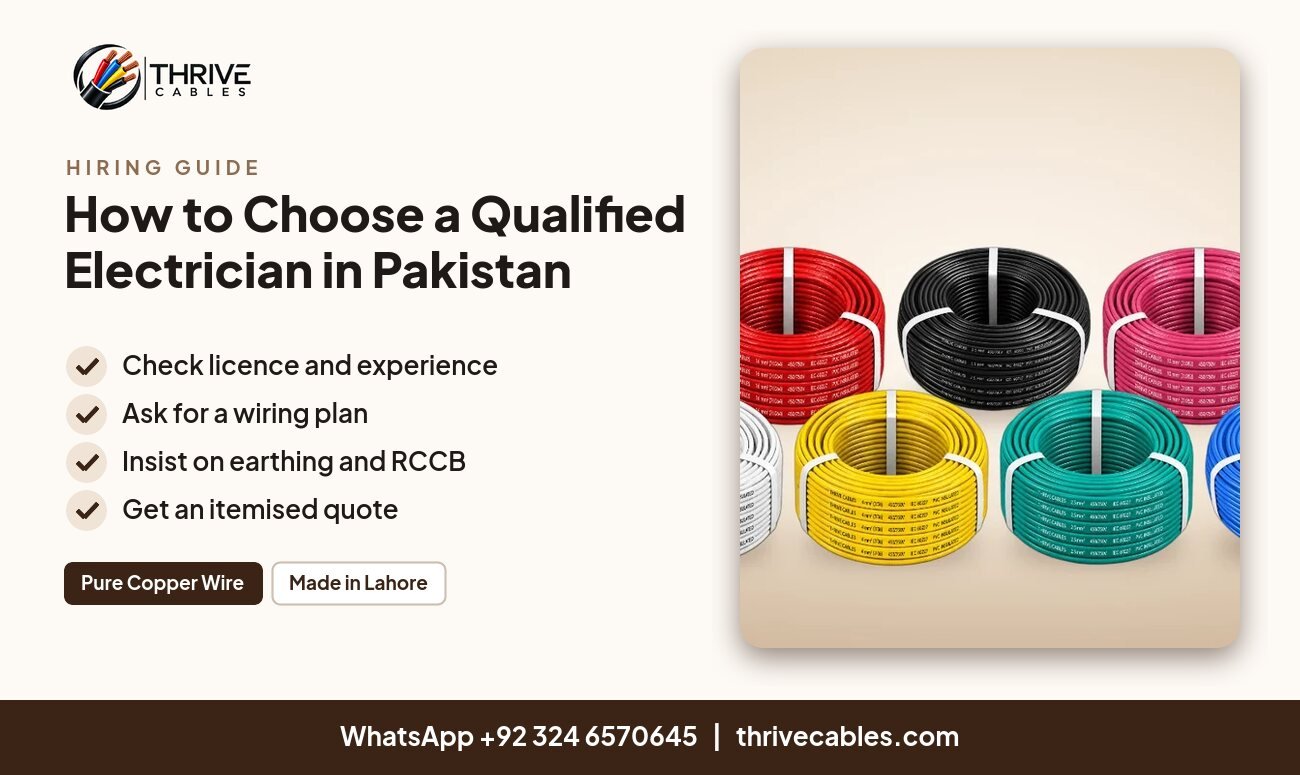
Many homeowners prefer to buy the wire themselves so they know exactly what goes into the walls. Thrive Cables supplies pure copper single core wire made in Lahore, with fire-retardant PVC insulation, in full-length 90 m coils and 7 colours, at factory price. Share the wiring plan with us on WhatsApp at +92 324 6570645 and we will help you work out the coils for each size. You can also use our coil calculator.
Should I choose the cheapest electrician?
Not on price alone. Compare itemised quotes, experience and references. Poor workmanship costs far more to fix later.
Should the electrician or I buy the wire?
Either works, but buying it yourself from a known manufacturer lets you control quality and check sizes and coil lengths.
What should I ask for at handover?
A list or drawing of all circuits with wire sizes and breakers, labelled breakers in the DB, and the test results.
A qualified electrician plans the load, gives every heavy appliance its own line, installs earthing and an RCCB, uses the right wire size for each circuit and tests everything before handover. Ask the 10 questions above, watch for the red flags, check the work on site, and use pure copper wire you can trust.
Tell us the size and quantity. We reply on WhatsApp the same day.