You build or renovate a house, the electrician hands you a list of wires, and the dealer asks “kaunsi size chahiye?” Most people pick whatever the last house used. A few months later the kitchen breaker keeps tripping, a socket behind the iron turns brown, or the main line feels warm when two ACs run together.
Almost every one of these problems has one cause: the wire size does not match the load on that circuit. A wire too thin for its load heats up, wastes electricity and damages its own insulation. A wire far too thick is simply money spent for nothing.
This guide explains which wire size to use for each part of a house in Pakistan, from lights and sockets to the AC, geyser and main line, with a starting plan for 5 marla, 10 marla and 1 kanal homes.
In Pakistan, single core copper wire is sold under inch-based names (3/29, 7/29, 7/36) and metric sizes (1 mm², 2.5 mm², 4 mm², 6 mm²). Both describe how much copper is inside, and that decides how much current the wire can carry safely.
In 7/29, the 7 is the number of copper strands and .029 is the diameter of each strand in inches. Seven strands of 0.029 inch give roughly 3 mm² of copper. The rule is simple: more copper area means more current capacity.
| Wire name | Strands × strand diameter | Approx. copper area | Typical use in a house |
|---|---|---|---|
| 1 mm² | stranded | 1 mm² | Light points only |
| 3/.029″ | 3 × 0.029″ | about 1.25 mm² | Lights and fans |
| 2.5 mm² | stranded | 2.5 mm² | Normal sockets |
| 7/.029″ | 7 × 0.029″ | about 3 mm² | Power sockets, 1–1.5 ton AC |
| 7/.036″ (4 mm²) | 7 × 0.036″ | about 4–4.5 mm² | 2 ton AC, electric geyser, kitchen line |
| 7/.044″ (6 mm²) | 7 × 0.044″ | about 6–7 mm² | Main line for a small house, sub-mains |
| 7/.052″ | 7 × 0.052″ | about 9–10 mm² | Main line for a medium house |
| 7/.064″ (16 mm²) | 7 × 0.064″ | about 14–16 mm² | Main line for a large house or heavy load |
| 1/.044″ earthing | 1 solid × 0.044″ | about 1 mm² | Earth continuity connections |
These copper areas are approximate, as a general guide. A wire’s current rating also depends on how it is installed, its length and the temperature.
A house is not wired with one size. It is divided into circuits, and each circuit gets the wire size that matches what it feeds.
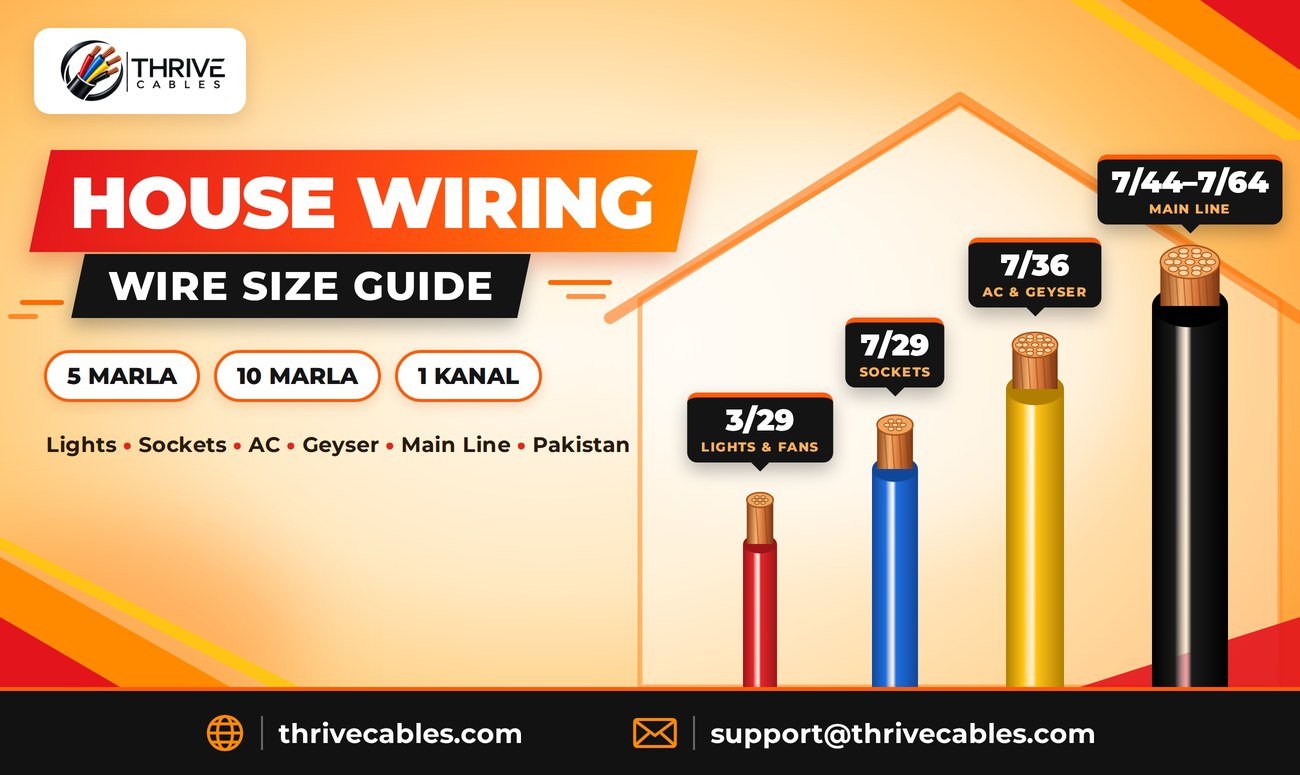
Lights and fans draw very little current, so a thin wire is enough. 3/29 wire is the most common choice in Pakistan for light and fan points, and 1 mm² wire is also used for light-only circuits with LED lighting. Never put sockets on a light circuit; someone will eventually plug in an iron.
Socket circuits feed chargers and TVs, but also irons, kettles and heaters, so they need a stronger wire than lights. 7/29 wire is the standard choice in most homes, with 2.5 mm² wire as the metric alternative. For the details, read our 3/29 vs 7/29 wire comparison.
The kitchen is the heaviest socket area: microwave, oven, kettle and air fryer often run together. Give it its own circuit with 7/29 wire at minimum, or 4 mm² (7/36) wire where an electric oven or several heavy appliances are used.
Every AC needs its own dedicated line from the distribution board. As a general guide, 7/29 wire works for a 1 or 1.5 ton AC on a short run, and 7/36 (4 mm²) wire for a 2 ton AC or a long run. See the full breakdown in which wire size is best for AC in Pakistan.
An electric geyser is one of the biggest single loads in a home and runs for long hours in winter. Use a dedicated line with 7/36 (4 mm²) wire, and check the wattage of any instant heater with your electrician.
The main line carries the current of the whole house, so it must be the thickest wire in the system. It is also the line most often undersized to save money. The right size depends on total load, number of ACs and distance from the meter:
To compare the two middle sizes in detail, read 7/36 vs 7/44 wire: which one should you use.
Earthing protects people from electric shock when an appliance develops a fault. 1/.044 solid earthing wire is used for earth continuity connections, while the main earth conductor size should be decided by your electrician.
Every house is different, but most homes in Pakistan follow a similar pattern. Use the table below as a starting point to check your electrician’s list, not as a final design.
| Circuit | 5 Marla | 10 Marla | 1 Kanal |
|---|---|---|---|
| Lights and fans | 3/29 or 1 mm² | 3/29 or 1 mm² | 3/29 or 1 mm² |
| Normal sockets | 7/29 or 2.5 mm² | 7/29 or 2.5 mm² | 7/29 or 2.5 mm² |
| Kitchen sockets | 7/29 | 7/29 or 7/36 | 7/36 |
| 1–1.5 ton AC (each) | 7/29 | 7/29 | 7/29 or 7/36 for long runs |
| 2 ton AC (each) | 7/36 | 7/36 | 7/36 |
| Electric geyser | 7/36 | 7/36 | 7/36 |
| Main line (meter to board) | 7/44 | 7/52 | 7/64 |
| Earthing | 1/.044 + earth as advised | 1/.044 + earth as advised | 1/.044 + earth as advised |
For quantity, most single core wire is sold in coils of 90 meters (97 gaz). Your electrician can estimate how many coils of each size you need from the house layout. Always confirm with a qualified electrician for your exact load and installation.
Matching each wire to its load is not just a technical detail. It saves money and protects the house every single day.
Most wiring problems come from a small set of repeated mistakes, and avoiding them costs nothing at the planning stage.
Run through this short checklist with your electrician before you place your order.
Thrive Cables manufactures single core copper wire at its facility in Lahore and supplies homeowners, electricians, contractors and dealers all over Pakistan. Every size in this guide, from 1 mm², 3/29, 2.5 mm² and 7/29 up to 7/64 and earthing wire, is made with pure copper, true gauge, fire-retardant PVC insulation and full-length 90 meter coils.
These are the questions homeowners and buyers ask most often when planning house wiring.
Which wire is used for house wiring in Pakistan?
Most homes use 3/29 or 1 mm² for lights and fans, 7/29 or 2.5 mm² for sockets, 7/36 for heavy loads like a 2 ton AC or electric geyser, and 7/44, 7/52 or 7/64 for the main line depending on the house size and load.
Can I use 7/29 wire for the whole house?
You can, but it is not necessary. Using 7/29 for light points adds cost without any benefit, and 7/29 is too thin for the main line of most houses. Matching each circuit to its load is safer and more economical.
Which wire size is used for the main line of a 5 marla house?
As a general guide, 7/44 (6 mm²) is common for a 5 marla house with one or two ACs. If you plan more ACs or the meter is far from the board, your electrician may recommend a thicker size.
How many coils of wire are needed for a 10 marla house?
It depends on the layout, number of points, number of ACs and the number of floors. Share your house plan with your electrician to estimate the coils of each size. Each Thrive coil is 90 meters (97 gaz).
What is the price of house wiring wire in Pakistan?
Wire price changes with the copper price, so it varies from week to week. Current price on request. Contact Thrive Cables for the latest price on every size, including wholesale price for dealers and contractors.
The rule of thumb for house wiring in Pakistan is simple: thin wire for light loads, stronger wire for sockets and heavy appliances, and the thickest wire for the main line. In practice that means 3/29 or 1 mm² for lights and fans, 7/29 or 2.5 mm² for sockets, 7/36 for a 2 ton AC and geyser, and 7/44 to 7/64 for the main line depending on the size of the house.
Plan every circuit before you buy, give each AC its own line, never skip earthing, and always choose pure copper wire that is true to its size and full length. Then confirm the final list with a qualified electrician for your exact load and installation.
Tell us the size and quantity. We reply on WhatsApp the same day.