You are about to buy wire for a new house and the dealer asks a simple question: “kitne coil chahiye?” The electrician gives a rough number, a friend says he used double that, and the dealer suggests buying extra “just in case”. Buy too few and the work stops halfway through. Buy too many and expensive copper sits unused in a storeroom.
The number of wire coils a house needs depends on the number of points, the size of each circuit, the layout and the number of floors. There is no single number that fits every 5 marla or 10 marla house. But there is a simple method that lets you estimate your own quantity and check your electrician’s list before you spend the money.
This guide gives you an easy coil calculator for house wiring in Pakistan: a simple formula, a fill-in worksheet and a worked example for a 5 marla or 10 marla house, plus the common mistakes that lead to overbuying or running short.
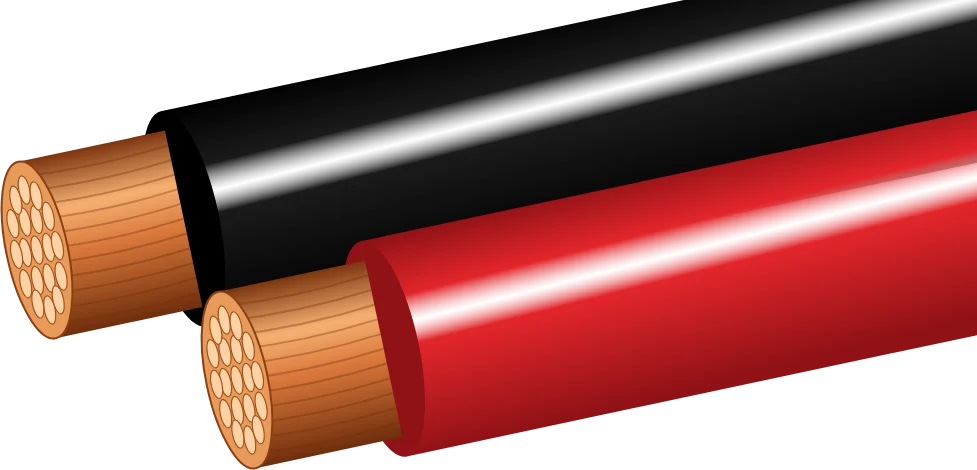
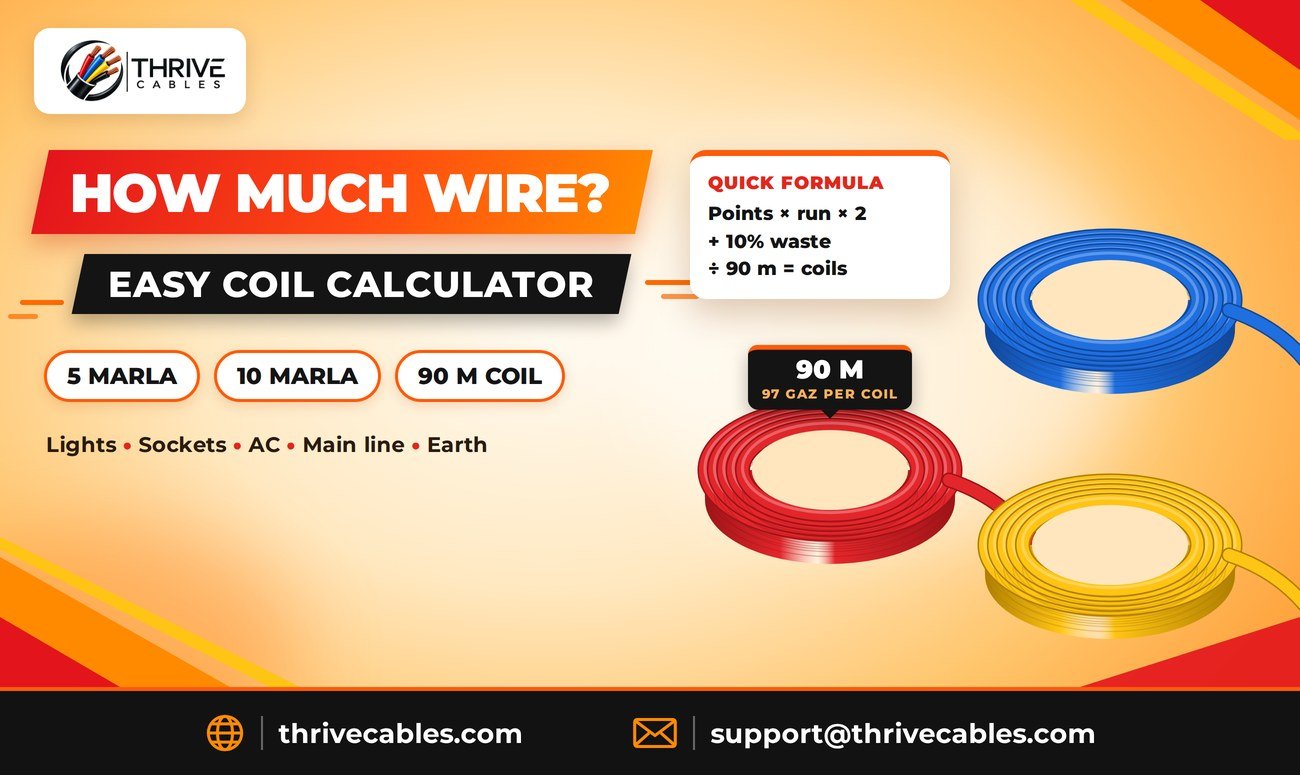
Single core house wire in Pakistan is normally sold in coils of 90 meters (97 gaz). Every size, from 3/29 for lights to 7/44 for the main line, comes in this length, but the amount of copper and the price of each coil are very different.
Before estimating, make sure the coils you buy are actually full length. A coil marked 90 meters that measures less means your estimate falls short and you buy more than planned. Our guide on how to identify fake or low-quality electric wire in Pakistan explains how to check.
A house uses different wire sizes for different circuits, so you cannot estimate one total and buy one size. Each size has to be counted separately.
For the right size for each circuit, see which wire size to use for house wiring in Pakistan.
Use this formula for each wire size separately. It is the same method electricians use for a quick estimate.
Coils needed = (number of points × average run per point × 2 + 10% for waste) ÷ 90
For dedicated lines such as an AC, geyser or the main line, use the measured run instead of points × average run. Then fill in this worksheet with your own house plan:
| Wire size / circuit | Points or runs | Average run (m) | × 2 conductors | + 10% | ÷ 90 = coils |
|---|---|---|---|---|---|
| Lights and fans (3/29 or 1 mm²) | ____ | ____ | ____ | ____ | ____ |
| Sockets (7/29 or 2.5 mm²) | ____ | ____ | ____ | ____ | ____ |
| ACs, geyser, kitchen (7/29 or 7/36) | ____ | ____ | ____ | ____ | ____ |
| Main line (7/44, 7/52 or 7/64) | 1 | ____ | ____ | ____ | ____ |
| Earth wire | ____ | ____ | × 1 | ____ | ____ |
Round every result up to the next full coil.
This method works for any house size. It takes about fifteen minutes with your house plan and your electrician.
The numbers below are an example only, to show how the method works. Your own house will have different point counts and run lengths, so use your own figures.
| Circuit | Example points / runs | Example calculation | Example total | Coils (90 m) |
|---|---|---|---|---|
| Lights and fans (3/29) | 20 points × 8 m | 20 × 8 × 2 = 320 m, +10% | about 352 m | 4 |
| Sockets (7/29) | 15 points × 8 m | 15 × 8 × 2 = 240 m, +10% | about 264 m | 3 |
| 2 ACs (7/29 or 7/36) | 2 runs × 15 m | 2 × 15 × 2 = 60 m, +10% | about 66 m | 1 |
| Main line (7/44) | 1 run × 15 m | 15 × 2 = 30 m, +10% | about 33 m | 1 |
| Earth wire | Socket and AC runs | 15 × 8 + 2 × 15 = 150 m, +10% | about 165 m | 2 |
In this example, the house needs about 4 coils of light wire, 3 coils of socket wire, 1 coil for the ACs, 1 coil for the main line and 2 coils of earth wire. A double-storey house, a larger 10 marla layout or more ACs will increase each line. Always confirm the final quantities with a qualified electrician for your exact load and installation.
Two houses of the same size can need very different quantities. These are the factors that change the number most.
Each floor adds vertical runs, a sub-distribution board in many cases and longer distances from the meter. A double-storey 5 marla house often needs noticeably more wire than a single-storey one.
Every AC, geyser and kitchen line needs its own dedicated run. Three or four ACs in a 10 marla house add a lot of heavier wire to the order.
A meter at the gate and a distribution board at the back of the house mean a long main line run, which adds main line wire and may require a bigger size.
Modern homes have more sockets, more lights and more switch points than older ones. Kitchens with several appliance sockets, bedrooms with sockets on both sides of the bed and lounges with decorative lighting all add points. More points means more wire.
How the electrician routes the conduits also matters. Runs that go up to the ceiling and back down, or around rooms instead of across them, use more wire per point. A planned conduit layout keeps runs short and reduces both wire and labour.
A simple estimate saves money and keeps the job on schedule.
Most estimating errors come from a few repeated habits.
Use this checklist with your electrician before you place the order.
Thrive Cables manufactures single core copper wire at its facility in Lahore in every size a house needs, from 1/.044 earthing wire and 3/29 to 7/64. Every coil is pure copper, true to gauge, insulated with fire-retardant PVC and a full 90 meters (97 gaz) long, so your estimate matches what you actually receive.
These are the questions homeowners ask most often when ordering wire.
How many meters are in one wire coil?
A standard single core wire coil in Pakistan is 90 meters, which is 97 gaz. Always confirm the coil is full length before buying.
How many wire coils are needed for a 5 marla house?
It depends on the number of points, floors, ACs and the layout. Count the points, estimate the run per point, double for phase and neutral, add earth and around 10% waste, then divide by 90 meters for each size.
How many coils are needed for a 10 marla house?
A 10 marla house usually needs more of every size than a 5 marla house, especially socket and AC wire. Use the same step-by-step method with your house plan and confirm with your electrician.
Do I need separate coils for earth wire?
Yes. Earth wire is a separate conductor and should be counted separately from the phase and neutral wire.
What is the price of a wire coil in Pakistan?
Wire coil price changes with the copper price, so it varies from week to week. Current price on request. Contact Thrive Cables for the latest price on every size, including wholesale price for bulk orders.
There is no single coil count that fits every 5 marla or 10 marla house, but there is a simple way to work it out: count the points, estimate the runs, double for phase and neutral, add earth and waste, and divide by 90 meters for each size.
The rule of thumb is simple: estimate each wire size separately, plan for future load, and make sure every coil you buy is a full 90 meters (97 gaz) of pure copper. Then confirm the final quantities with a qualified electrician for your exact load and installation.
Tell us the size and quantity. We reply on WhatsApp the same day.