Talk to an electrician or read a wire coil and you will meet words like ampere, voltage drop, strands, insulation, MCB and earthing. They are simple ideas, but nobody explains them, so many homeowners agree to a wiring plan they do not fully understand. This glossary explains 20 common electrical wire terms in plain language, with examples from Pakistani homes.
The “pressure” that pushes electricity through a wire. Home supply in Pakistan is 230 V single phase, and about 400 V between phases on three-phase supply.
The amount of current flowing, like the amount of water in a pipe. Thicker wires can carry more amperes safely.
The power an appliance uses. Watts = volts × amps. A 2,000 W iron draws about 8.7 A at 230 V. 1 kW = 1,000 W.
What your electricity bill counts. One unit is 1 kW used for 1 hour.
The total power of the appliances on a circuit or in the whole house at one time.
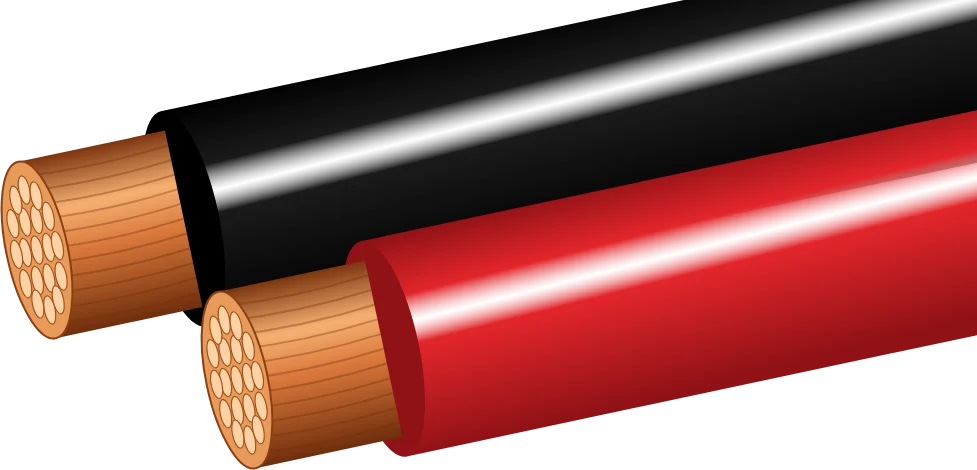
The metal inside the wire that carries current. In good house wire it is pure copper. See copper vs aluminium wire.
One of the thin copper wires twisted together to form a stranded conductor. “7/29” means 7 strands, each 0.029 inch thick.
A solid conductor is one single wire, like 1/.044 earthing wire. A stranded conductor has several strands and bends more easily. See solid vs stranded wire.
The cross-sectional area of copper in a wire, used for metric sizes like 2.5 mm² and 4 mm². See imperial vs metric wire sizes.
The plastic covering (usually PVC) around the conductor that keeps current inside the wire and protects people.
Insulation that resists catching fire and slows the spread of flame. See fire retardant vs fire resistant cable.
Single core wire has one insulated conductor. Multi core cable has two or more inside an outer sheath. See single core vs multi core cable.
The maximum voltage the insulation is designed for. 450/750V is the usual rating for single core house wire. See wire standards explained.
The maximum current a wire can carry safely without overheating. It depends on size, installation and temperature. See our wire load capacity chart.
How much a wire resists current. Thinner or impure wire has more resistance, so it wastes more energy as heat. See wire resistance and your electricity bill.
The loss of voltage along a wire, which grows with length and current. It causes dim lights and struggling ACs on long or undersized runs.
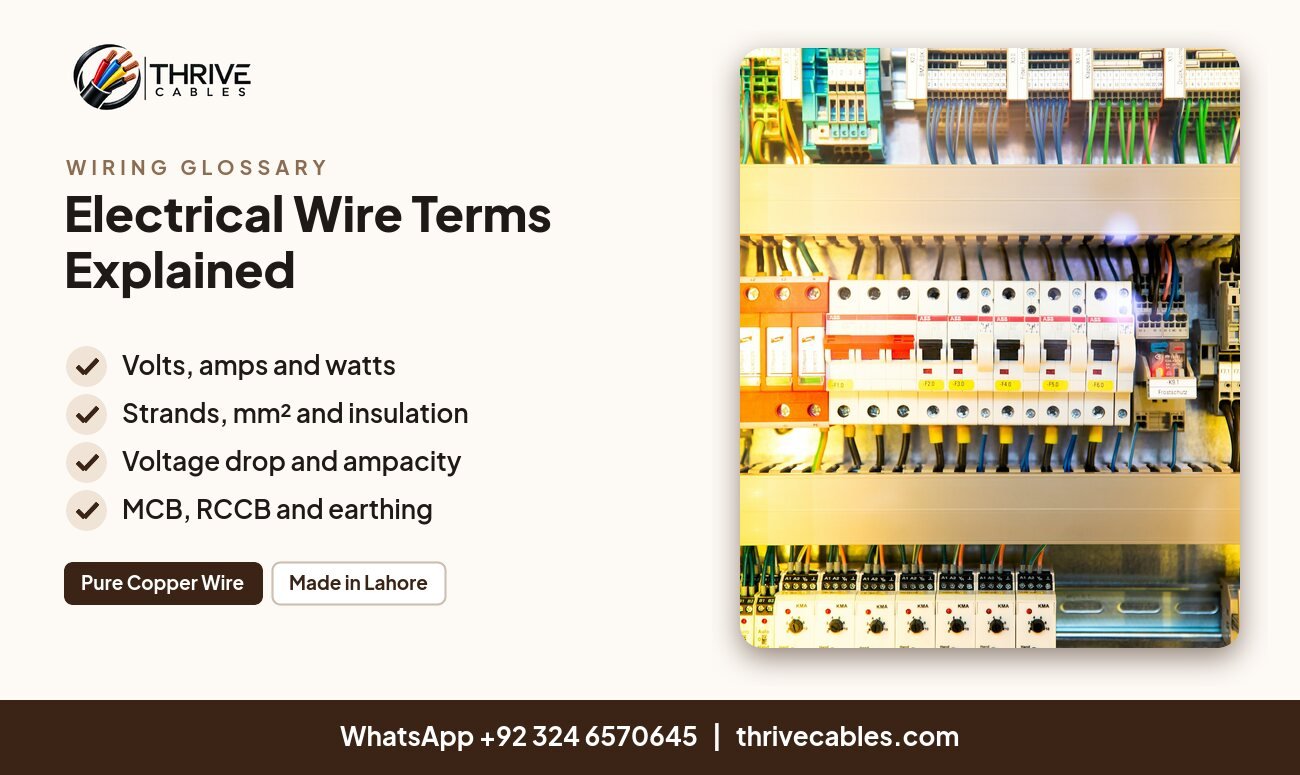
Switches off a circuit when the current is too high, protecting the wire from overload and short circuits.
Switches off the supply when current leaks to earth, protecting people from electric shock. See MCB vs RCCB.
When live and neutral (or earth) touch directly, causing a very large current and sparks. A correctly sized MCB trips almost instantly.
A safety path from appliances and sockets to the ground through an earth wire and earth pit, so fault current flows away safely. See earthing wire in Pakistan.
| Term | Meaning |
|---|---|
| DB | Distribution board, where the house supply is split into circuits |
| Main line | The wire from the meter to the DB, carrying the whole house load |
| Sub-main | A line from the main DB to another board, for example on an upper floor |
| Phase | The live wire (red in single phase) |
| Neutral | The return wire (black) |
| Conduit | The pipe inside walls through which wires are pulled |
| Coil | A roll of wire, usually 90 m |
For a picture of how these parts connect, see our house wiring diagram.
Thrive Cables makes single core house wire in Lahore with 99.9% pure copper, full-thickness strands and fire-retardant PVC insulation, in every size from 1 mm² to 7/64 and 7 colours. Ask anything about wire on WhatsApp at +92 324 6570645.
What does 7/29 mean on a wire?
7 copper strands, each 0.029 inch thick, giving about 3 mm² of copper.
What is the difference between amps and watts?
Amps measure current; watts measure power. Watts = volts × amps.
What is voltage drop?
The voltage lost along a wire. Longer or thinner wires lose more, which is why long runs need a bigger size.
Electrical wiring is easier to understand once the words make sense. Volts push, amps flow, watts measure power, and the right copper size, insulation, breakers and earthing keep it all safe. Keep this glossary handy when you plan your wiring, compare quotes or talk to your electrician.
Tell us the size and quantity. We reply on WhatsApp the same day.