When buying wire, you will often see words like “fire retardant”, “flame retardant” and “fire resistant” printed on coils, quoted by dealers or written in building specifications. They sound similar, and many people use them as if they mean the same thing. They do not. Each describes a different behaviour in a fire, and choosing the right one depends on where the cable is used.
This guide explains the difference in simple terms, where each type is used, and what kind of wire a normal house in Pakistan actually needs.
| Point | Fire retardant (flame retardant) | Fire resistant |
|---|---|---|
| Main job | Stops the cable from spreading the fire | Keeps the circuit working during a fire |
| What happens in a fire | Insulation burns slowly and tends to self-extinguish when the flame is removed | Cable keeps carrying power for a set time even while exposed to fire |
| Typical construction | Copper conductor with fire-retardant PVC insulation | Special fire barrier layers (for example mica tape) and special insulation |
| Typical use | House wiring, shops, offices | Fire alarms, emergency lights, fire pumps, smoke extraction |
| Cost | Standard | Much higher |
Fire retardant (also called flame retardant) wire uses insulation that is made to resist catching fire and to slow the spread of flame along the cable. If a flame touches the wire, the insulation does not keep burning like ordinary plastic. Once the source of the flame is removed, it tends to stop burning on its own.
This matters because house wiring runs through walls, ceilings and conduits across the whole building. If a fault starts a fire at one switchboard, ordinary insulation could carry the flame along the wiring to other rooms. Fire retardant insulation helps keep a small fault from becoming a big fire.
Fire resistant cable is designed for a different purpose. It is built to keep working while a fire is burning, so that critical safety equipment keeps power long enough for people to escape and for firefighters to work. These cables have special layers, such as mica tape around the conductor, which protect the circuit even when the outer insulation is damaged by heat.
They are used in large buildings for circuits such as:
For normal house wiring in Pakistan, good quality fire retardant PVC insulated copper wire is the standard and sensible choice. It covers lights, fans, sockets, AC lines and the main line. Fire resistant cable is usually specified by engineers for life-safety systems in hospitals, plazas, high-rise buildings and factories, not for ordinary home circuits.
Fire retardant insulation slows fire, but it cannot fix a badly designed installation. Most electrical fires start from:
So the safest approach combines fire retardant wire with the correct size for every circuit, tight terminals and the right protection. Our guide on which wire size to use for house wiring covers sizing room by room.
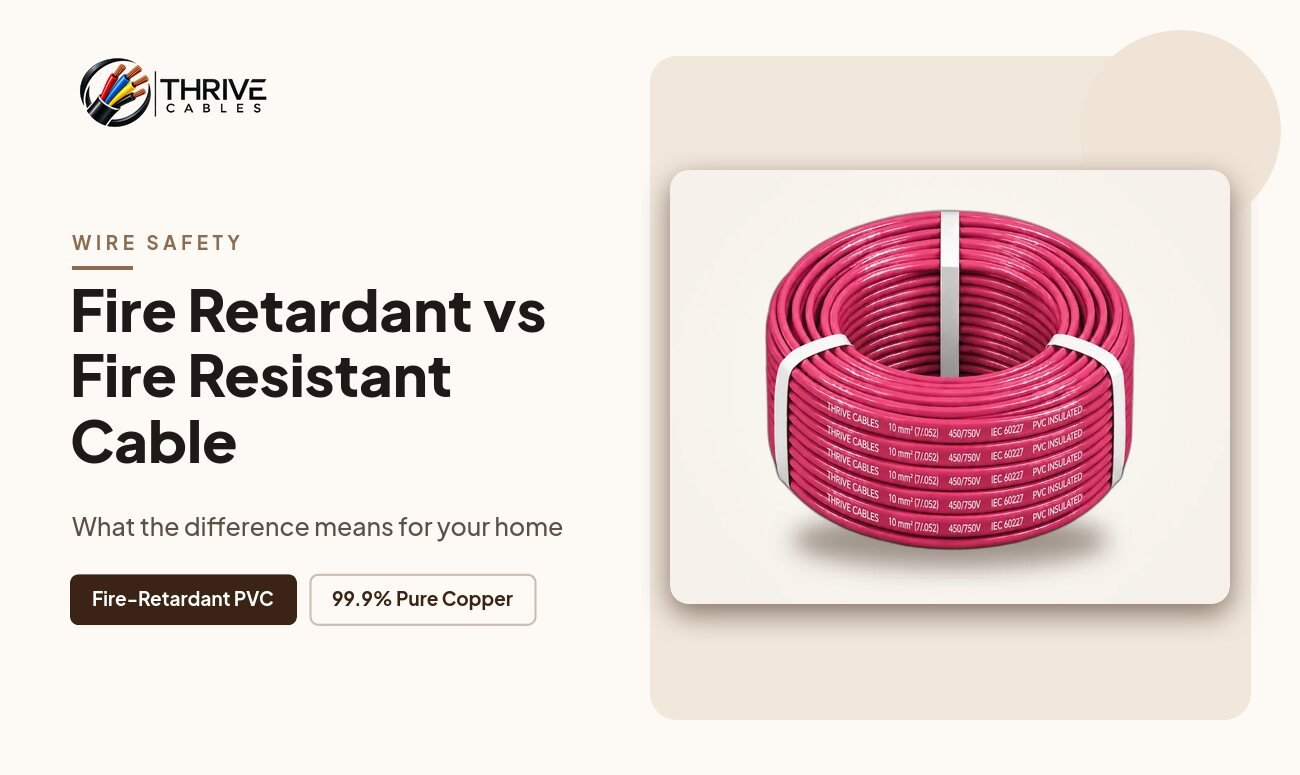
Thrive Cables single core wire is made in Lahore with 99.9% pure copper and fire-retardant PVC insulation, across the full house wiring range: 1 mm², 3/29, 2.5 mm², 7/29, 7/36, 7/44, 7/52, 7/64 and 1/.044 earthing wire. Order at factory price on WhatsApp at +92 324 6570645.
Is flame retardant the same as fire retardant?
Yes. Both terms describe insulation that resists catching fire and slows the spread of flame.
Is fire retardant wire fireproof?
No. It resists spreading fire, but it can still be damaged by a strong fire. Correct sizing and installation are still essential.
Do I need fire resistant cable for my house?
Usually not. Fire resistant cable is used for life-safety circuits like fire alarms and emergency lighting in larger buildings.
Why is fire resistant cable so expensive?
It has extra protective layers and special materials so it can keep working during a fire, which makes it more costly to produce.
Fire retardant wire slows the spread of fire along the wiring, while fire resistant cable keeps critical circuits working during a fire. For homes, fire retardant PVC insulated pure copper wire, sized correctly and installed with tight connections and the right breakers, is the practical and safe choice. Leave fire resistant cable for the life-safety systems that engineers specify in larger buildings.
Tell us the size and quantity. We reply on WhatsApp the same day.