The electrician’s list says 7/29, the product page says 2.5 mm², and the dealer is talking about “teen unteess” and “saat unteess”. Another shop sells the same job in 4 mm² and 6 mm². It is easy to get confused, buy the wrong size, or pay for a thicker wire than the circuit needs.
In Pakistan, wire sizes are sold in two naming systems at the same time: the older inch-based names like 3/29 and 7/29, and the metric sizes in mm². Both describe the same thing: how much copper is inside the wire. Once you understand how they line up, choosing the right size for each circuit becomes simple.
This guide gives you a complete electric wire size chart for Pakistan, explains how to read sizes like 7/29, converts every size to mm², and shows where each one is used in a house.
The inch-based wire name has two numbers. The first number is how many copper strands the wire has. The second number is the diameter of each strand in thousandths of an inch.
So 7/29 means 7 strands, each 0.029 inch thick. 3/29 means 3 strands of the same thickness. 7/44 means 7 thicker strands of 0.044 inch each. 1/.044 means a single solid conductor of 0.044 inch.
To turn this into mm², you work out the copper area of one strand and multiply by the number of strands. For example, one strand of 0.029 inch (about 0.74 mm) has an area of roughly 0.43 mm², so seven strands give roughly 3 mm². The bigger the total copper area, the more current the wire can carry safely.
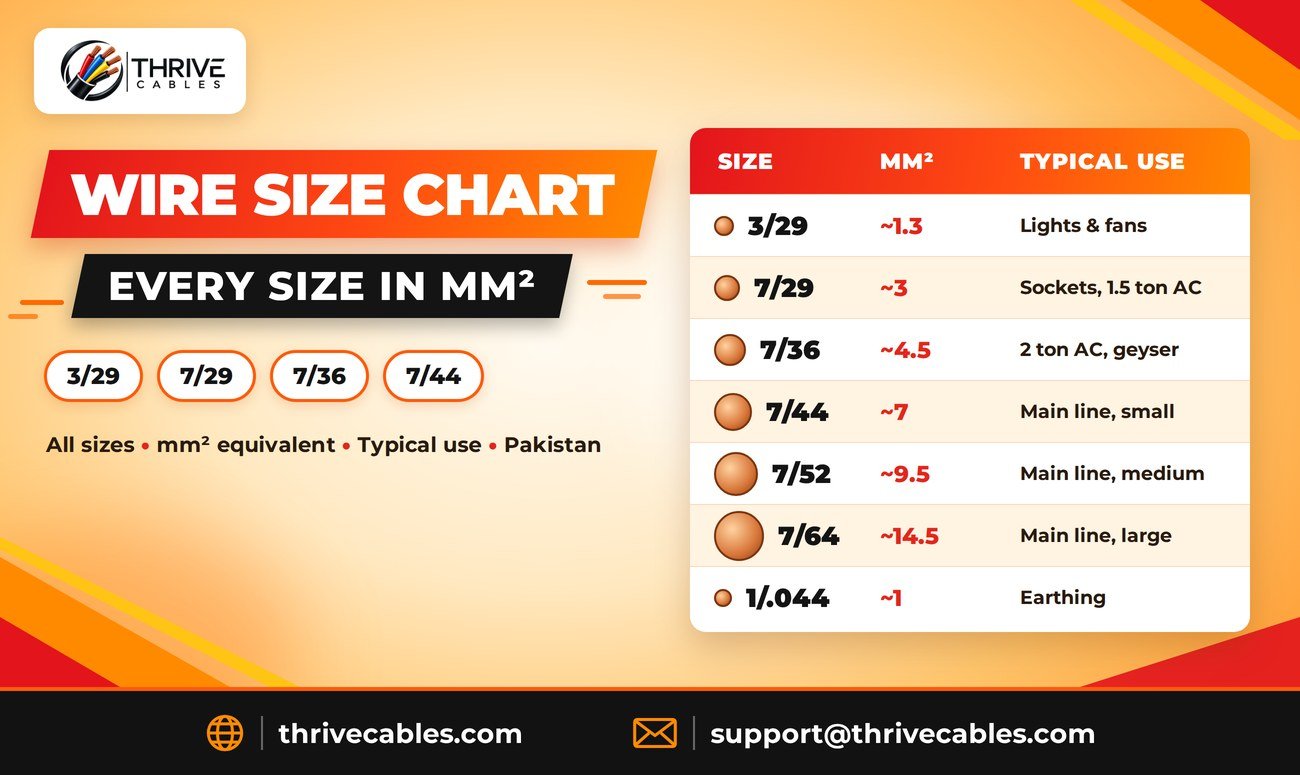
This chart lists the common single core copper wire sizes used in Pakistan, their approximate copper area and their typical use in a house. The mm² values are approximate and given as a general guide.
| Wire size | Strands × strand diameter | Approx. copper area | Nearest metric class | Typical use |
|---|---|---|---|---|
| 1/.044″ earthing | 1 solid × 0.044″ | about 1 mm² | 1 mm² | Earth connections, light circuit earth |
| 1 mm² | stranded | 1 mm² | 1 mm² | Light points |
| 3/.029″ | 3 × 0.029″ | about 1.3 mm² | 1.5 mm² class | Lights and fans |
| 2.5 mm² | stranded | 2.5 mm² | 2.5 mm² | Normal sockets |
| 7/.029″ | 7 × 0.029″ | about 3 mm² | 2.5–3 mm² class | Power sockets, 1–1.5 ton AC |
| 7/.036″ (4 mm²) | 7 × 0.036″ | about 4.5 mm² | 4 mm² | 2 ton AC, geyser, kitchen line |
| 7/.044″ (6 mm²) | 7 × 0.044″ | about 7 mm² | 6 mm² | Main line, small house; sub-mains |
| 7/.052″ | 7 × 0.052″ | about 9.5 mm² | 10 mm² | Main line, medium house |
| 7/.064″ (16 mm²) | 7 × 0.064″ | about 14.5 mm² | 16 mm² | Main line, large house, heavy load |
The current a wire can carry also depends on how it is installed (in conduit, inside a wall or in open air), its length and the room temperature, so always confirm with a qualified electrician for your exact load and installation.
Both systems are sold side by side in Pakistan, and both work if the size matches the load. The important thing is to compare the copper area, not the name.
Inch-based sizes like 7/29 and 7/36 are still the most familiar names for electricians and dealers, especially for house wiring. Metric sizes like 2.5 mm² and 4 mm² match international standards and are often specified by engineers and in project drawings. When a drawing says 2.5 mm² and the dealer offers 7/29, ask your electrician to confirm the equivalent for your circuit. What matters is that the copper area is at least what the circuit needs, whichever name is printed on the coil.
A label only tells you what the wire is supposed to be. A few simple checks at the dealer help you confirm that the wire matches the chart before you buy.
A wire gauge or micrometer gives the most accurate strand measurement, and many electricians carry one.
A house is divided into circuits, and each circuit needs the size that matches its load. This is the most common pattern in homes in Pakistan.
Light and fan circuits draw little current. 3/29 or 1 mm² wire is enough for these points. If you are unsure between 3/29 and 7/29, read our 3/29 vs 7/29 wire comparison.
Socket circuits feed irons, kettles and heaters as well as chargers and TVs, so they need a stronger wire. 7/29 or 2.5 mm² is the standard choice.
Heavy appliances need their own lines. 7/29 works for a 1 or 1.5 ton AC on a short run, and 7/36 (4 mm²) is used for a 2 ton AC, an electric geyser or a heavy kitchen line. See our AC wire size guide.
The main line from the meter to the distribution board carries the whole house load. 7/44, 7/52 or 7/64 are used depending on the total load and distance. Compare the middle sizes in 7/36 vs 7/44 wire and the heavier sizes in 7/52 vs 7/64 wire.
Using the chart correctly saves money and protects the house at the same time.
Most wrong purchases come from confusing names or ignoring the copper inside.
Use this short checklist with your electrician when you place your order.
For a full plan by house size, see which wire size to use for house wiring in Pakistan.
Thrive Cables manufactures every size in this chart at its facility in Lahore, from 1/.044 earthing wire and 3/29 to 7/64. Each size is pure copper, true to gauge, insulated with fire-retardant PVC and supplied in full-length 90 meter (97 gaz) coils for homeowners, electricians, contractors and dealers all over Pakistan.
These are the questions buyers ask most often about wire sizes.
What does 7/29 mean in wire size?
7/29 means the wire has 7 copper strands, each 0.029 inch thick. Together they give roughly 3 mm² of copper.
Is 3/29 equal to 1.5 mm²?
3/29 has roughly 1.3 mm² of copper, so it sits in the same class as 1.5 mm² for light and fan circuits. For an exact match on a project drawing, confirm with your electrician.
Which is thicker, 7/36 or 7/44?
7/44 is thicker. Its strands are 0.044 inch compared to 0.036 inch, which gives roughly 7 mm² of copper compared to roughly 4.5 mm².
Which wire size is used for house main line in Pakistan?
As a general guide, 7/44 is common for a small house, 7/52 for a medium house and 7/64 for a large house or heavy load. The exact size depends on total load and distance.
What is the price of each wire size in Pakistan?
Wire price changes with the copper price, so it varies from week to week. Current price on request. Contact Thrive Cables for the latest price on every size.
Wire sizes in Pakistan come in two names, but they describe the same thing: the amount of copper inside. Read the inch name as strands × strand diameter, check the mm² equivalent, and choose the size that matches the load on each circuit.
The rule of thumb is simple: 3/29 or 1 mm² for lights, 7/29 or 2.5 mm² for sockets, 7/36 for heavy appliances, and 7/44 to 7/64 for the main line. Then confirm the final list with a qualified electrician for your exact load and installation.
Tell us the size and quantity. We reply on WhatsApp the same day.