Your house is growing. A second floor is coming up, a third AC is on the list, and the electrician says the old main line from the meter will not be enough. Now the question is whether to go with 7/52 or 7/64. One is noticeably cheaper, the other is noticeably thicker, and both are sold as “main line wire”.
The main line is the single most important wire in a building. It carries the current for every light, socket, AC and geyser at the same time. If it is too thin, it heats up, voltage drops at the far end of the house, and the risk of a fault at the meter or the distribution board goes up. If it is far thicker than needed, you have spent extra money for nothing.
This guide compares 7/52 and 7/64 wire on the three things that decide the choice: size, load and distance. It explains what each size means and shows which one fits which kind of house, shop or building in Pakistan.
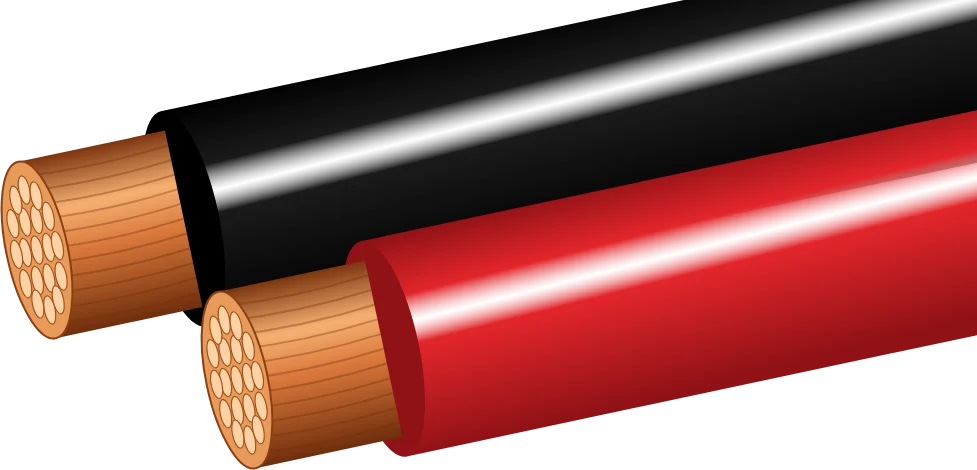
Both 7/52 and 7/64 are stranded single core copper wires made with 7 strands. The difference is the thickness of each strand.
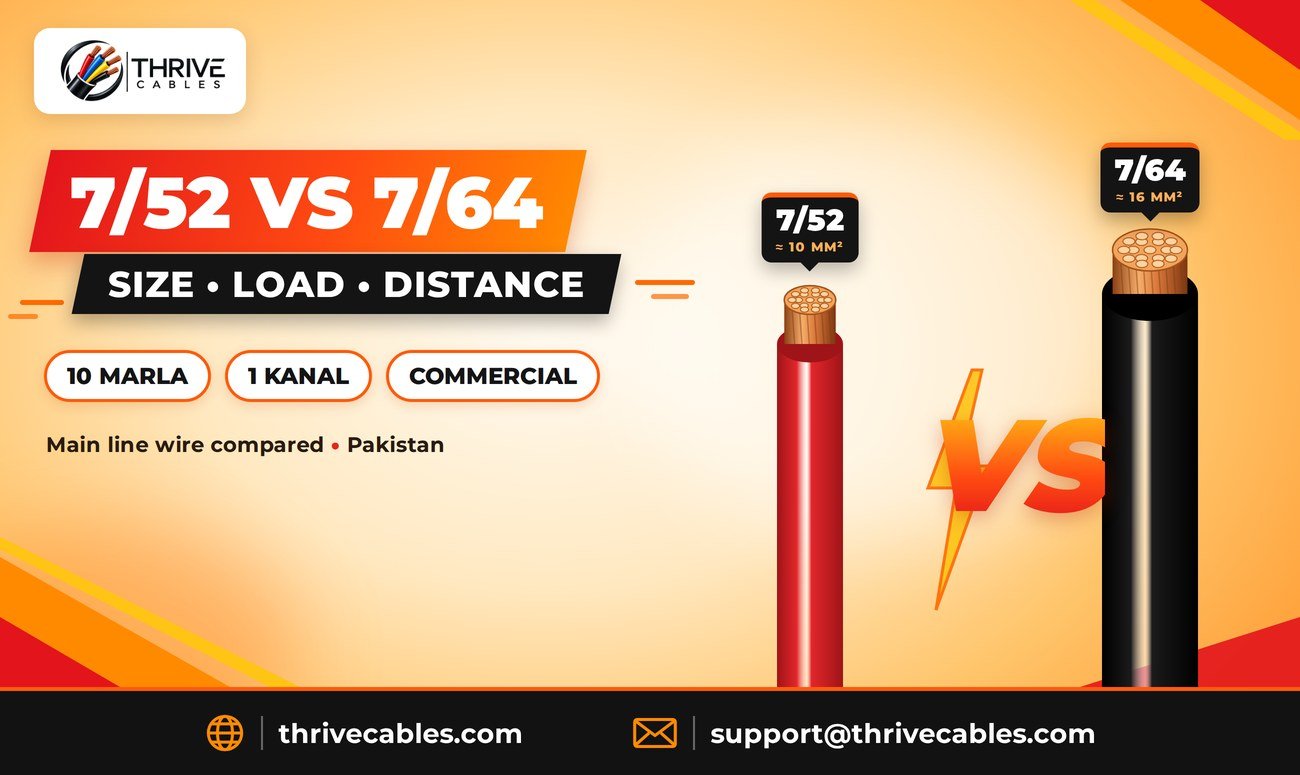
In 7/52, each of the 7 strands is 0.052 inch thick. Together they give roughly 9.5 mm² of copper, which places it in the 10 mm² class.
In 7/64, each of the 7 strands is 0.064 inch thick. Together they give roughly 14.5 mm² of copper, which places it in the 16 mm² class.
That means 7/64 has roughly 50% more copper than 7/52. More copper means it can carry more current, runs cooler at the same load and has less voltage drop over the same distance. For the full range of sizes, see our wire size chart for Pakistan.
This table compares the two sizes on the points that matter most for a main line. Values are approximate and given as a general guide.
| Point | 7/52 wire | 7/64 wire |
|---|---|---|
| Strands × strand diameter | 7 × 0.052″ | 7 × 0.064″ |
| Approx. copper area | about 9.5 mm² | about 14.5 mm² |
| Metric class | 10 mm² | 16 mm² |
| Relative copper | Base | About 50% more |
| Voltage drop over the same run | Higher | Lower |
| Typical use | Main line of a medium house, sub-mains | Main line of a large house, commercial load, long runs |
| Price | Lower | Higher |
| Handling | Easier to bend and terminate | Stiffer, needs larger lugs and terminals |
7/52 is a strong main line size for many medium-size homes and small commercial spaces in Pakistan. It is a step up from 7/44 and gives comfortable headroom for most family houses.
As a general guide, 7/52 suits:
If your house is smaller, compare 7/36 vs 7/44 wire first; you may not need 7/52 at all.
7/64 is the heavier choice for buildings with high total load or long distances. It gives the most headroom in the single core range and keeps the voltage steady at the far end of the building.
As a general guide, 7/64 suits:
Voltage drop is the loss of voltage along a wire. The longer the wire and the higher the current, the bigger the drop. At the end of a long, undersized main line, ACs struggle to start, lights dim when heavy appliances switch on, and motors run hot.
Because 7/64 has roughly 50% more copper, its voltage drop over the same distance and load is roughly a third lower than 7/52. If your meter is at the gate and the distribution board is at the back of a large house or on an upper floor, the extra copper in 7/64 can make a real difference. Your electrician can calculate the exact drop for your run and tell you whether the extra cost of 7/64 is justified for your building.
Larger homes, plazas, factories and workshops in Pakistan are often supplied with a three-phase connection. In that case, the load is shared across three phase wires plus a neutral, and each phase may need a heavy single core wire.
As a general guide, 7/52 is often used per phase for medium commercial loads, while 7/64 is used where each phase carries a heavy or continuous load, or where the run is long. The neutral should not be smaller than the phase wire where loads are unbalanced. Because three-phase design depends on load sharing and distance, it should always be planned by a qualified electrician.
The main line is installed once and is expensive to replace, so getting the size right pays off for years.
Most main line problems in Pakistan come from a few repeated mistakes.
This quick reference shows where each main line size fits, alongside the full Thrive range for other circuits.
| House or building | Main line wire (general guide) |
|---|---|
| 5 marla, one or two ACs | 7/44 (6 mm²) |
| 10 marla, three or four ACs | 7/52 |
| 1 kanal or larger, many ACs | 7/64 (16 mm²) |
| Long run from meter | One size up from the above |
For the rest of the house: 3/29 or 1 mm² for lights, 7/29 or 2.5 mm² for sockets, 7/36 for heavy appliances and 1/.044 earthing wire for earth connections. See the full plan in which wire size to use for house wiring in Pakistan. Always confirm with a qualified electrician for your exact load and installation.
Thrive Cables manufactures 7/52 and 7/64 single core copper wire at its facility in Lahore, along with the full range from 1/.044 to 7/44. Every size is pure copper, true to gauge, insulated with fire-retardant PVC and supplied in full-length 90 meter (97 gaz) coils for homeowners, contractors and dealers all over Pakistan.
These are the questions buyers ask most often when choosing a main line wire.
What is the difference between 7/52 and 7/64 wire?
Both have 7 copper strands, but 7/64 strands are thicker (0.064 inch compared to 0.052 inch). 7/64 has roughly 50% more copper, so it carries more current and has less voltage drop.
Is 7/52 equal to 10 mm²?
7/52 has roughly 9.5 mm² of copper, which places it in the 10 mm² class. For an exact match on a project drawing, confirm with your electrician.
Is 7/64 equal to 16 mm²?
7/64 has roughly 14.5 mm² of copper, which places it in the 16 mm² class used for heavier main lines.
Which wire is best for the main line of a 10 marla house?
As a general guide, 7/52 suits a 10 marla house with three or four ACs. If the run from the meter is long or you plan more load, 7/64 gives extra headroom.
What is the price of 7/52 and 7/64 wire in Pakistan?
Wire price changes with the copper price, so it varies from week to week. Current price on request. Contact Thrive Cables for the latest price, including wholesale price for contractors and dealers.
7/52 and 7/64 are both strong main line sizes, but they serve different loads. 7/52 is the practical choice for many medium houses and small commercial spaces, while 7/64 is the right choice for large houses, heavy commercial load, long runs and future expansion.
The rule of thumb is simple: size the main line from the total load and distance, not from habit, and go one size up when the run is long or more ACs are planned. Then confirm the final choice with a qualified electrician for your exact load and installation.
Tell us the size and quantity. We reply on WhatsApp the same day.