Every unit of electricity your house uses passes through one line: the main line from the meter to the distribution board (DB). If that line is too thin, it heats up, the voltage drops when the AC starts, and the main breaker trips at the worst time. If it is far thicker than needed, you pay for copper you never use.
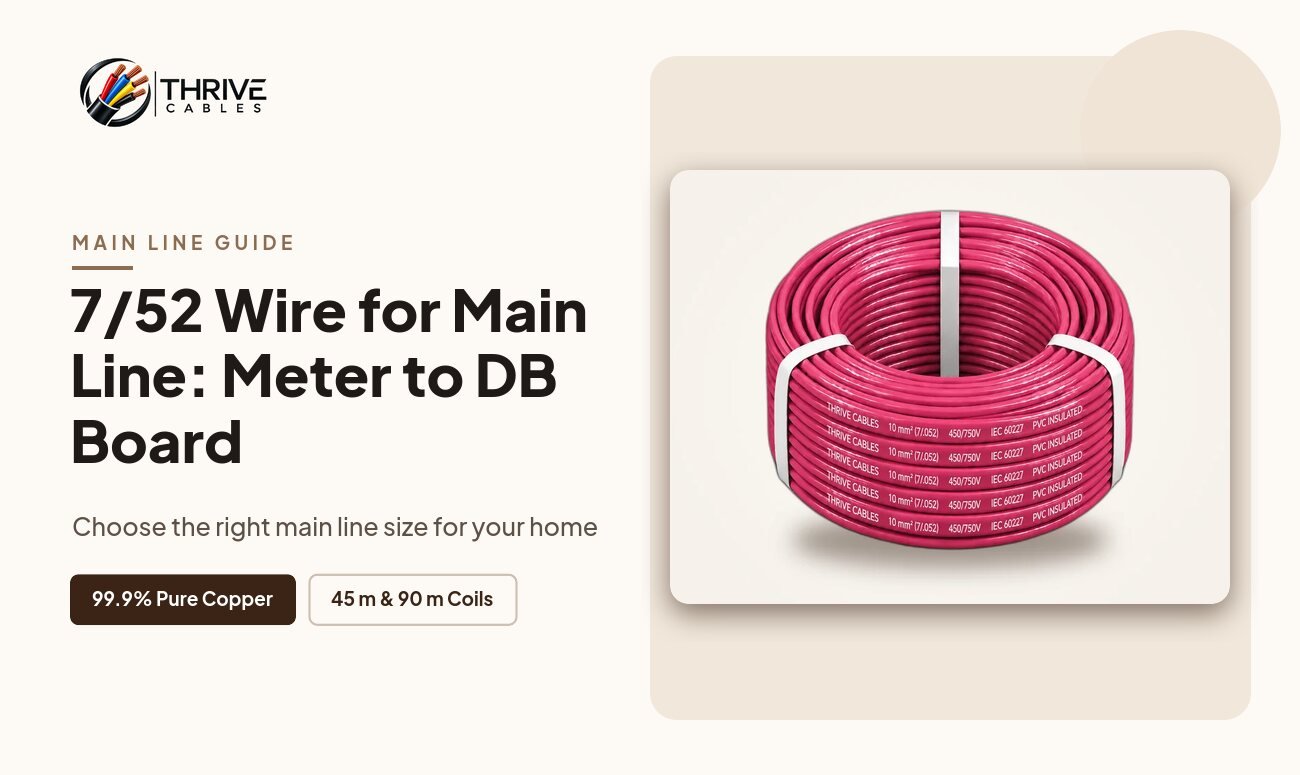
For most medium-sized homes in Pakistan, the answer lands on 7/52 wire. This guide explains why, how to tell whether your house needs 7/52 or a different size, and how to install the main line properly.
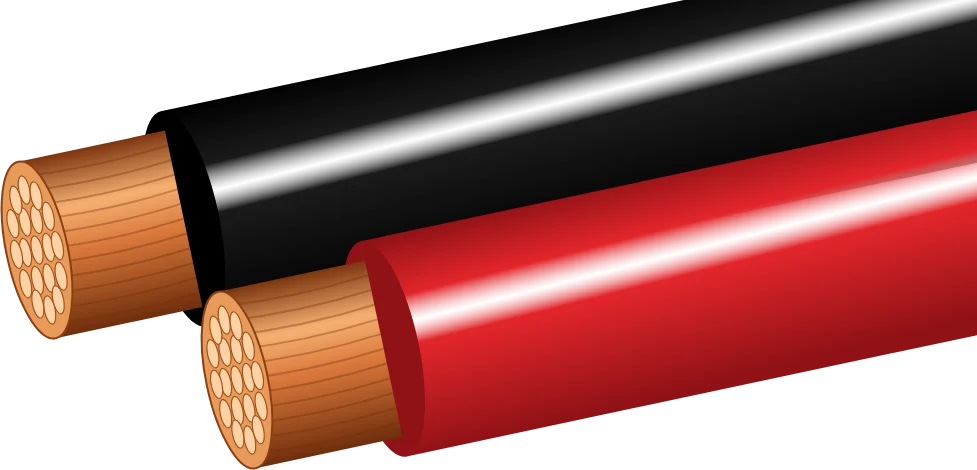
The main line is the pair of wires (phase and neutral) that runs from the outgoing terminals of the electricity meter to the main switch or main breaker of your DB. From the DB, smaller wires branch out to lights, sockets and appliances. The main line carries the total current of all of them at once, so it must be the thickest wire in a single phase house.
| Detail | 7/52 wire |
|---|---|
| Construction | 7 strands, each 0.052 inch thick |
| Cross-section | About 9.6 mm² (the 10 mm² class) |
| Typical current (in conduit) | Roughly 50 to 57 A |
| Common main breaker | 40 A to 50 A (as advised) |
| Best for | Main line in medium houses, sub-mains |
A typical 7 to 10 marla house in Pakistan has two or three air conditioners, a fridge, a washing machine, an iron, a water pump and lights and fans across several rooms. Not everything runs at once, but on a summer evening the load can easily reach 7 to 10 kW.
At 230 V, 10 kW is about 43 A. 7/52 can carry roughly 50 to 57 A in conduit, so it handles that peak with a sensible safety margin. The thinner 7/44 (6 mm²) is close to its limit at this load, while 7/64 is more than most of these homes need.
Follow these steps before buying the main line wire.
Write down every appliance that uses a lot of power: air conditioners, electric geysers, ovens, irons, pumps and heaters. These decide the main line size far more than lights and fans do.
Three ACs, a fridge and lights on a hot night is a realistic peak. A geyser and three ACs together is not common. Use the realistic peak, not the total of everything.
Divide the peak load in watts by 230. For example, 9,000 W divided by 230 is about 39 A.
Choose a wire that can carry the peak current comfortably, not one that is just at its limit. Leave space for one more AC in the future.
If the meter is more than about 20 to 25 metres from the DB, the voltage drop on a thinner wire can become noticeable. A longer run may need one size bigger.
| House and load | Typical main line |
|---|---|
| 5 marla, 1 to 2 ACs | 7/44 (6 mm²) |
| 7 to 10 marla, 2 to 3 ACs | 7/52 |
| 1 kanal, 4+ ACs or long run | 7/64 (16 mm²) |
| Three-phase supply | 7/52 or 7/64 per phase, as advised |
This is a starting point. The final size should always be confirmed by a qualified electrician for your exact load and installation. For a closer look at the two largest sizes, read 7/52 vs 7/64 wire compared.
A good wire can still fail if the installation is poor. These points matter most.
If you notice any of these, have an electrician check the main line before the summer peak.
Thrive Cables makes 7/52 single core copper wire in Lahore with 99.9% pure electrolytic copper, full-thickness strands and fire-retardant PVC insulation. It is available in 45 m and 90 m coils in 7 colours, so the phase, neutral and earth can each have their own colour. Contractors and dealers can get factory prices on WhatsApp at +92 324 6570645.
Which wire is best for the main line of a house in Pakistan?
For most 7 to 10 marla houses, 7/52 is the most practical choice. Smaller houses with light load can use 7/44, and large or three-phase houses usually use 7/64.
How many amps can 7/52 wire carry?
Roughly 50 to 57 A inside conduit, depending on installation and temperature. The main breaker is usually 40 A to 50 A.
Should the neutral be thinner than the phase?
No. In a single phase house, the neutral carries the same current as the phase and should be the same size.
Is 7/44 enough for a main line?
For a small house with one or two ACs, yes. For more load, move up to 7/52. See 7/36 vs 7/44 wire for how 7/44 compares.
How much main line wire do I need?
Measure the route from the meter to the DB, double it for phase and neutral, and add a few metres for bends and terminations. Our wire coil calculator helps with the full house.
The main line is the backbone of a home’s wiring. For most medium houses in Pakistan, 7/52 copper wire carries the evening peak with room to spare, keeps voltage steady and lasts for decades when installed with proper lugs and a matching neutral. Work out your realistic peak load, allow for future appliances, and confirm the final size with a qualified electrician.
Tell us the size and quantity. We reply on WhatsApp the same day.