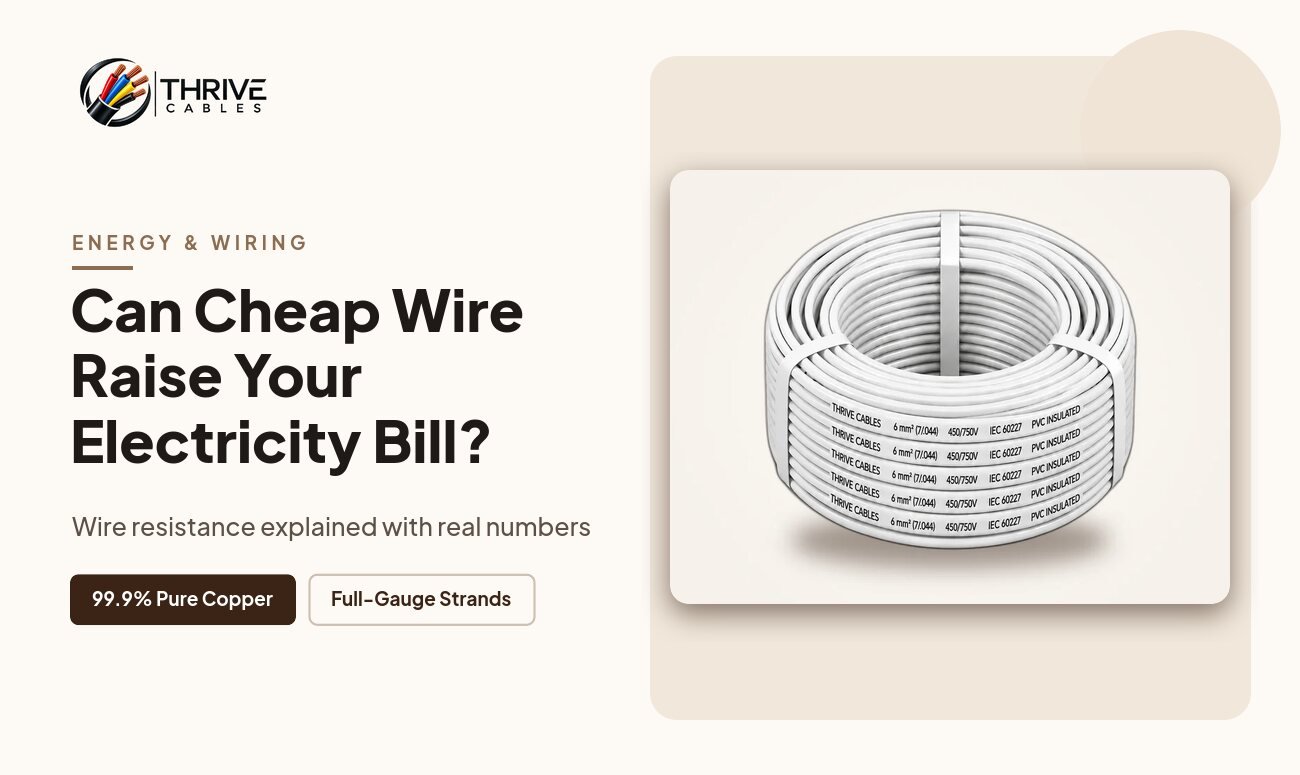
With electricity tariffs rising, people look for every way to bring the bill down. One claim you will hear is that cheap or thin wire “bijli ka bill barha deti hai”. Is that true? The honest answer is yes, a little, and the bigger damage is somewhere else. This guide explains how wire resistance wastes electricity, works through real examples with numbers, and shows what actually matters when choosing wire.
Every wire has some resistance. When current flows through it, a small part of the energy turns into heat inside the wire instead of reaching your appliance. The lost power follows a simple rule:
Power lost in the wire = current × current × resistance
Two things raise resistance:
Because the loss depends on current squared, it matters most on circuits that carry heavy current for long hours: the main line and AC lines.
A 1.5 ton AC drawing about 9 A, on a 20 metre run (40 metres of wire counting phase and neutral).
| Wire | Resistance (approx.) | Loss at 9 A |
|---|---|---|
| Genuine 7/36 (about 4.6 mm² copper) | 0.15 Ω | About 12 W |
| Undersized “4 mm²” (really about 3 mm²) | 0.23 Ω | About 19 W |
The difference is about 7 W. Over a summer of 8 hours a day for 150 days, that is roughly 8 units (kWh). Real, but small on its own.
A main line carrying 40 A on a summer evening, 15 metres from meter to DB (30 metres of wire).
| Wire | Resistance (approx.) | Loss at 40 A |
|---|---|---|
| 7/52 (about 9.6 mm²) | 0.054 Ω | About 86 W |
| 7/44 (about 6.9 mm²) | 0.075 Ω | About 120 W |
Here the difference is around 34 W at peak. If the house runs near that load for 6 hours a day across a 150 day summer, that adds up to roughly 30 units a season, and more if the wire is also impure or the run is longer. These figures use the resistance of pure copper at 20°C; warm wire in summer has a little more resistance.
Yes, but for most homes the extra units from wire loss alone are modest. The real costs of undersized or low-quality wire are bigger and harder to see:
Good wiring helps, but the biggest savings usually come from the appliances themselves: inverter ACs set at a sensible temperature, LED lighting, efficient fridges and switching off unused loads. Good wiring makes sure that every unit you pay for reaches those appliances safely.
Thrive Cables manufactures single core wire in Lahore with 99.9% pure electrolytic copper, full-thickness strands and fire-retardant PVC insulation, so each size carries the copper it is marked for. Order at factory price on WhatsApp at +92 324 6570645.
Does thicker wire save electricity?
Slightly. Thicker wire has lower resistance, so less power is lost as heat, especially on heavy circuits like the main line.
Can bad wiring cause a high electricity bill?
Wire losses add a modest number of units. A sudden large rise in the bill is more likely caused by appliances, a faulty meter or current leakage, which an electrician should check.
Is aluminium wire more expensive to run?
For the same size, aluminium has higher resistance, so it loses more power and runs hotter than copper.
Cheap or undersized wire does waste some electricity, usually a modest number of units per season, with the largest losses on the main line and AC lines. The bigger price is paid in heat, voltage drop, damaged appliances and repair work. Pure copper wire of a genuine size, with short runs and tight connections, keeps losses low and the house safe.
Tell us the size and quantity. We reply on WhatsApp the same day.