Inverter ACs have become the default choice in Pakistan because they save electricity. A common belief has come with them: “inverter AC kam bijli leta hai, is liye patli wire bhi chal jayegi.” It is true that an inverter AC usually uses less power on average. But the wire must be sized for the most current the AC can draw, not the average, and that is where many installations go wrong.
This guide explains how inverter ACs draw power, which wire size to use for 1 ton, 1.5 ton and 2 ton inverter ACs, and how to install the line properly.
Maximum power varies by brand and model. Always check the rating plate or manual for the maximum input current, and have your electrician confirm the wire and breaker.
How an Inverter AC Draws Power
A normal (non-inverter) AC runs its compressor at full speed, switches off when the room is cool, then starts again with a large surge. An inverter AC changes its compressor speed. It starts gently, runs hard to cool the room quickly, then slows down to hold the temperature.
Starting current is lower than a non-inverter AC, which is good for the wiring.
Average power is lower, which saves electricity.
Maximum power can still be high. On a hot afternoon, when the room is warm, the AC runs at full or even boosted speed for long periods.
That maximum, sustained current is what heats the wire, so the wire must be sized for it.
Why 4 mm² Is the Safe Standard for Inverter ACs
It carries the maximum current comfortably with room to spare, even in a hot roof or crowded conduit.
It keeps voltage drop low. Inverter ACs are sensitive to low voltage. Low voltage at the outdoor unit can cause error codes, poor cooling and stress on the electronics.
It allows for an upgrade. If you later replace a 1 ton with a 1.5 or 2 ton AC, the line is already suitable.
When to Use a Bigger Wire
If the outdoor unit is far from the DB, such as on the roof of a double-storey house, voltage drop increases with length. For long runs, especially with a 2 ton inverter AC, use 7/44 (6 mm²). Your electrician can calculate the drop for your exact distance.
Inverter AC on Solar or UPS
Many homes now run inverter ACs from a solar inverter or hybrid system. On the AC side (230 V), the wire from the solar inverter’s output to the DB and from the DB to the AC follows the same rules as normal house wiring: size it for the maximum current, keep runs short and connections tight. The DC side between solar panels and the inverter uses dedicated solar DC cable, which is a different product.
Installation Checklist for an Inverter AC Line
Dedicated line from the DB with its own breaker. Never share it with sockets.
Phase, neutral and earth all run to the AC. Red, black and green make the line easy to identify.
Use a proper isolator or heavy-duty socket near the indoor or outdoor unit, as the installer recommends.
No joints in the wall wherever possible. Run one continuous length.
Tighten every terminal at the breaker, isolator and AC terminal block.
Use the manufacturer’s interconnecting cable between indoor and outdoor units, as specified in the manual.
Running it from a normal socket circuit because “inverter uses less power”.
Using 3/29 or 1 mm² lighting wire for the AC. These are far too small.
No earth connection to the outdoor unit.
A breaker too large for the wire.
Loose joints taped inside the wall.
Why Choose Thrive Cables for AC Lines
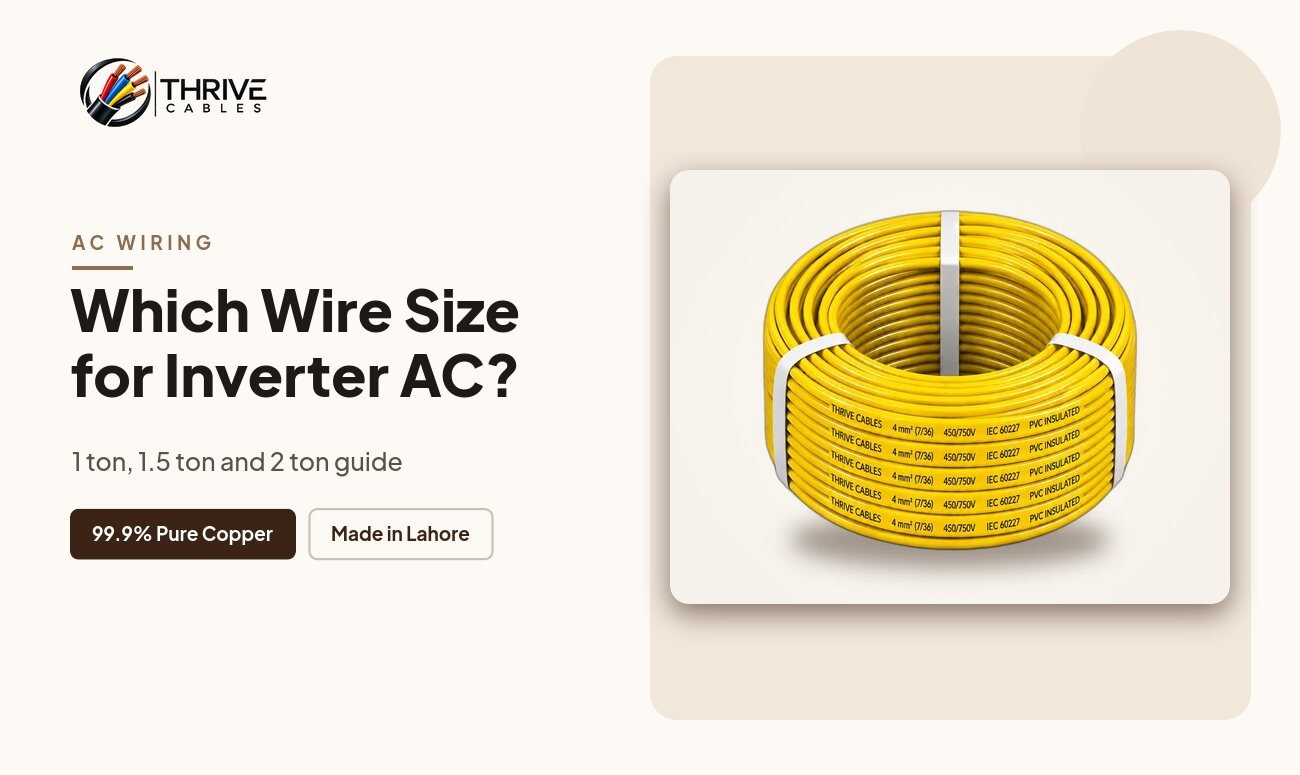
Thrive Cables makes 4 mm² (7/36) and 7/44 single core wire in Lahore with 99.9% pure copper and fire-retardant PVC insulation, in 45 m and 90 m coils and 7 colours. Order at factory price on WhatsApp at +92 324 6570645.
Frequently Asked Questions
Does an inverter AC need a thinner wire?
No. It uses less power on average, but its maximum current can still be high. Size the wire for that maximum, usually 4 mm².
Can I use 2.5 mm² for a 1 ton inverter AC?
On a short dedicated run it may work, but 4 mm² is the safer choice and allows a future upgrade.
Which breaker for a 1.5 ton inverter AC?
A 20 A breaker on a 4 mm² line is common. Check the AC’s manual and confirm with your electrician.
Conclusion
An inverter AC saves electricity, but it does not need a thinner wire. Size the line for its maximum current, which for 1 to 2 ton models usually means a dedicated 4 mm² (7/36) line, and 7/44 for long runs. Run phase, neutral and earth, tighten every connection and let a qualified electrician confirm the installation.