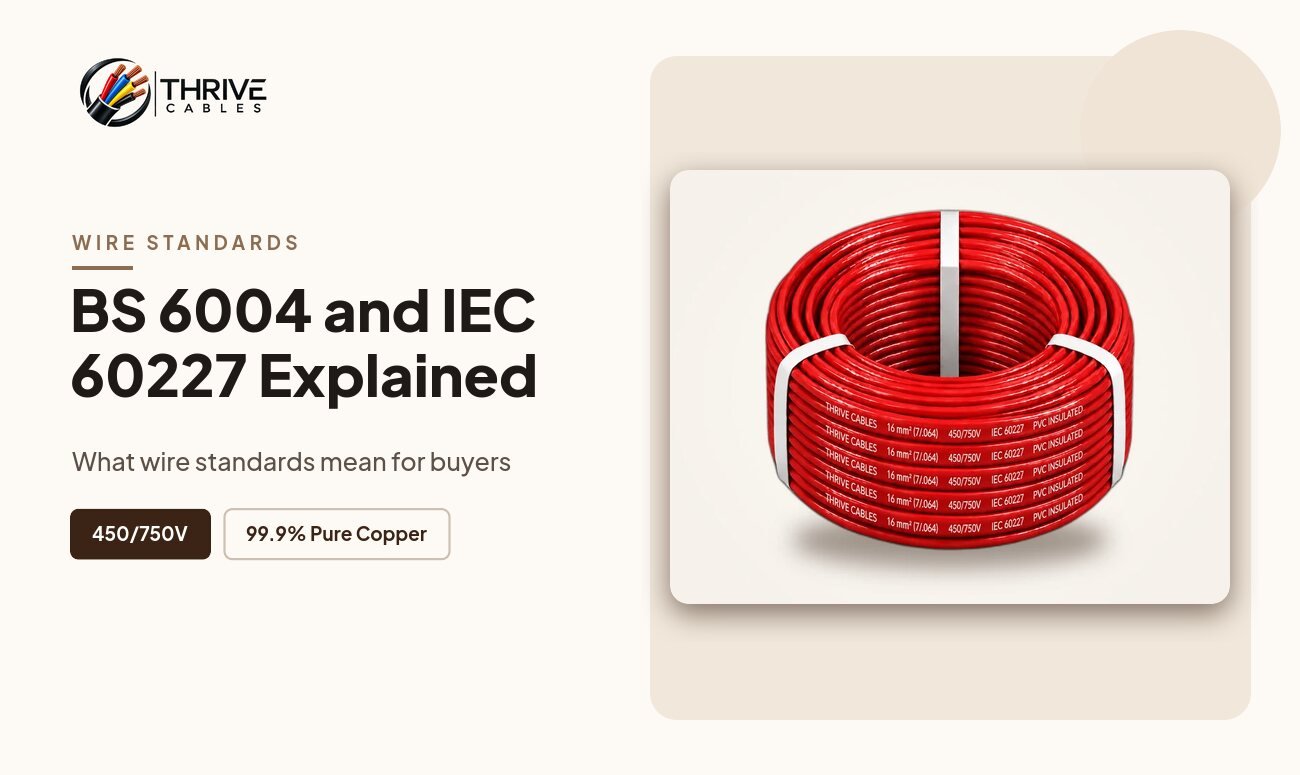
Look closely at the printing on a wire coil and you will often see codes like “450/750V”, “IEC 60227” or “BS 6004”. Engineers and contractors ask for them in specifications, but most buyers do not know what they mean or why they matter. In simple terms, a standard is a published rulebook that says how a wire must be built and tested so that it performs safely.
This guide explains the main wire standards you will see in Pakistan, what each one covers and how to use them when buying wire.
| Standard | What it covers |
|---|---|
| IEC 60227 | International standard for PVC insulated cables rated up to 450/750 V, including single core building wire |
| BS 6004 | British standard for PVC insulated, non-armoured cables for building wiring (much of it now continued in BS EN 50525) |
| IEC 60228 | Conductor standard: classes of conductor and the maximum resistance for each size |
| PSQCA | Pakistan Standards and Quality Control Authority, the national body for standards and product certification |
450/750V is the voltage rating of the insulation. The first number is the rated voltage between a conductor and earth, and the second is the rated voltage between two conductors. Home supplies in Pakistan are 230 V single phase and 400 V three-phase, so wire rated 450/750V has a healthy margin for house wiring.
IEC 60227 sets the rules for PVC insulated cables up to 450/750 V. For single core house wire, it covers things like:
BS 6004 is the British standard for PVC insulated building cables. Because Pakistan’s wiring practice has strong British roots, BS 6004 is often named in local specifications, and it covers both metric sizes and the traditional imperial sizes such as 3/.029 and 7/.029. Much of its content for single core cables has since been carried into the European standard BS EN 50525, but the BS 6004 name is still widely used.
IEC 60228 is one of the most useful standards for buyers, because it sets the maximum resistance allowed for each conductor size. A wire with impure copper, fewer strands or thinner strands will have higher resistance than the limit, even if it is marked with the right size.
| Copper size | Max resistance at 20°C (stranded, IEC 60228) |
|---|---|
| 1 mm² | 18.1 Ω per km |
| 1.5 mm² | 12.1 Ω per km |
| 2.5 mm² | 7.41 Ω per km |
| 4 mm² | 4.61 Ω per km |
| 6 mm² | 3.08 Ω per km |
| 10 mm² | 1.83 Ω per km |
| 16 mm² | 1.15 Ω per km |
Contractors can test a sample with a good meter: measure the resistance of a full coil and compare it with the limit for its length. This is one of the most reliable ways to catch undersized wire. Read more in how to identify fake or low-quality electric wire.
See solid vs stranded wire for why each type is used.
Thrive Cables single core wire is made in Lahore with 99.9% pure copper and fire-retardant PVC insulation. Our coils are printed with the wire size, the 450/750V rating and IEC 60227, so you can see what you are buying. For full technical details on any size, contact us on WhatsApp at +92 324 6570645.
Is IEC 60227 the same as BS 6004?
They are different standards from different bodies, but both cover PVC insulated building cables and are similar in purpose.
What voltage rating should house wire have?
450/750V is the common rating for single core house wire.
How can I check if wire meets the standard?
Check the printing, count the strands and measure the strand diameter. For larger orders, test conductor resistance against IEC 60228 limits.
Wire standards are a simple way to know that a wire is built and tested properly. IEC 60227 and BS 6004 cover PVC building wire, IEC 60228 sets conductor resistance limits, and 450/750V tells you the insulation rating. Read the coil printing, check the strands and, for big jobs, test the resistance before the wire goes into the walls.
Tell us the size and quantity. We reply on WhatsApp the same day.