You compare two quotes for house wiring and one is noticeably cheaper. The dealer explains that the cheaper wire is “aluminium” or “copper coated”, and that it “works the same”. A year later a socket connection starts to spark, a joint behind the switchboard turns black, or the breaker trips every time the iron is used.
The choice between copper and aluminium wire is one of the most important decisions in any wiring job, but most homeowners make it on price alone. Both metals conduct electricity, and both are used in Pakistan. They behave very differently inside the walls of a house, though, and that difference shows up in safety, electricity loss and repair cost over the years.
This guide explains the 7 differences between copper and aluminium wire that every homeowner in Pakistan should know, where each metal is actually used, how to spot copper-clad aluminium sold as copper, and which one is the right choice for house wiring.
Before going through each difference, here is a quick side-by-side summary of how the two metals compare for wiring.
| Property | Copper wire | Aluminium wire |
|---|---|---|
| Conductivity | Excellent (reference) | Roughly 60% of copper |
| Size for the same current | Smaller | About one size larger |
| Weight | Heavier | Much lighter |
| Strength and flexibility | Strong, bends without breaking | Softer, more likely to crack when bent repeatedly |
| Behaviour at joints | Stable, tight connections | Oxidises and loosens over time |
| Fittings | Works with standard home fittings | Needs compatible terminals and connectors |
| Cost | Higher upfront, lower over the years | Lower upfront, higher risk of repair cost |
House wiring has many joints, bends and terminals in a small space: switchboards, sockets, light points, the distribution board and the meter. These 7 differences explain why the two metals perform so differently in that environment.
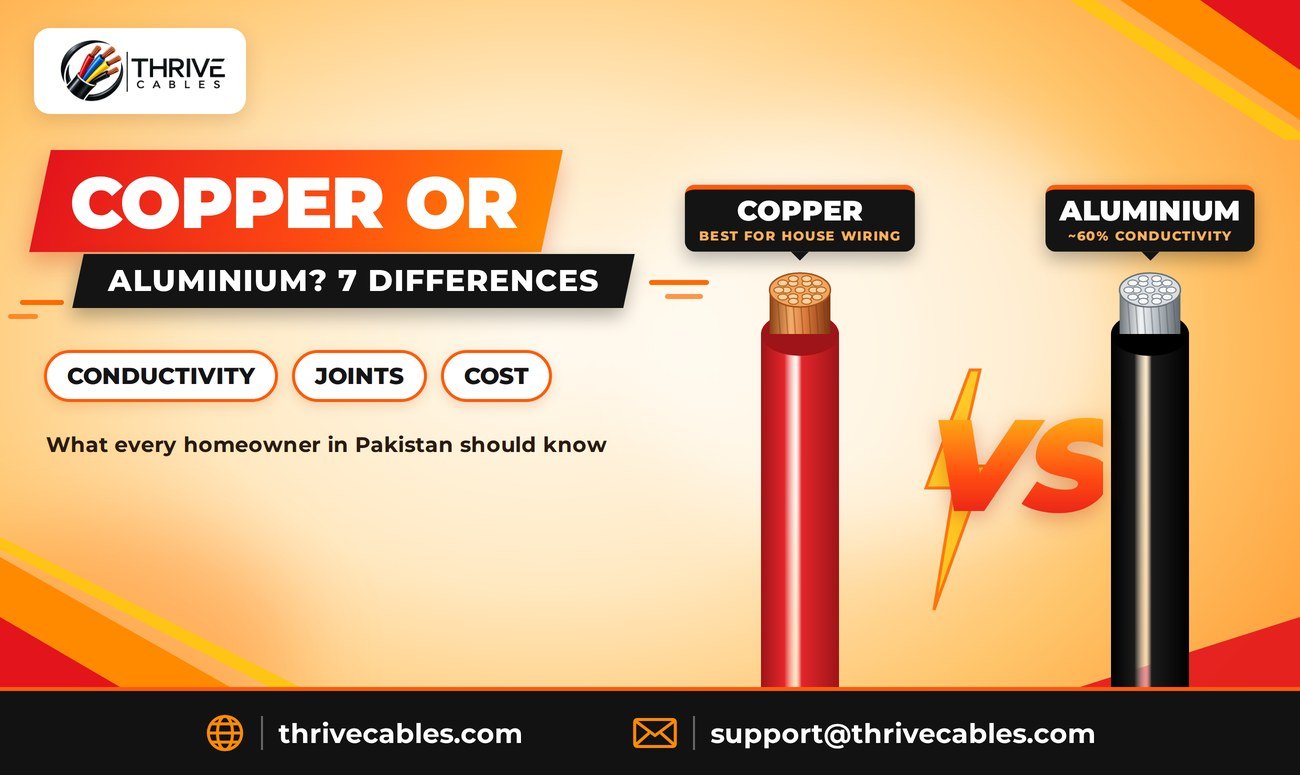
Copper is one of the best electrical conductors available. As a general guide, aluminium has roughly 60% of the conductivity of copper. A copper wire of a given size therefore runs cooler than an aluminium wire of the same size under the same load, wastes less electricity as heat and keeps its insulation healthy for longer.
Because aluminium conducts less, it needs a noticeably larger cross-section, often about one size up, to carry the same current as copper. A bigger wire takes more space in conduits and switch boxes, and needs larger terminals.
Aluminium weighs roughly a third as much as copper for the same volume. This is its biggest advantage, and the reason it is used for long overhead lines on poles, where weight matters more than size. Inside a house, the weight of the wire is not a real concern.
House wires are pulled through conduits, bent around corners and folded into switch boxes. Copper takes this handling without cracking. Aluminium is softer and can nick or break inside the insulation when bent repeatedly, which creates a hidden weak point.
This is the most important difference for safety. Aluminium forms a hard oxide layer on its surface that does not conduct well, and it expands and contracts more than copper as it heats and cools. Over months and years this loosens screw terminals. A loose terminal heats up, and a heated terminal is one of the most common causes of burnt sockets and switchboard fires.
Most sockets, switches, breakers and terminals sold for homes in Pakistan are designed for copper conductors. Aluminium needs compatible terminals and, where it meets copper, special bimetallic connectors. Joining the two metals at an ordinary joint causes corrosion.
Aluminium costs less per kilogram, so aluminium wire is cheaper on the day you buy it. Copper costs more upfront, but it wastes less electricity, needs fewer repairs and lasts the life of the building. Breaking walls to replace failed wiring costs far more than the price difference between the two metals. For what decides the copper price itself, see copper wire price in Pakistan: 8 things that decide what you pay.
Aluminium is not a “bad” metal. It has a clear place in the electrical system, but that place is mostly outside the house.
Inside a house, with dozens of small terminals and frequent bending, copper remains the safer and more reliable choice.
Choosing copper costs more on the first day, but it pays back across the life of the house.
A bigger risk than honest aluminium wire is wire that is sold as copper but is not. Copper-clad aluminium (often called CCA) has an aluminium core with a thin copper coating. On the outside it looks like copper.
CCA behaves like aluminium, not copper: it carries less current, heats more and has the same joint problems. Because it looks like copper, buyers often do not know what they have installed until faults begin.
Signs to watch for:
Read our full guide on how to identify fake or low-quality electric wire in Pakistan for more checks you can do at the dealer.
Most problems come from treating copper and aluminium as interchangeable. They are not.
If you are choosing copper, the next question is which size to use for each circuit. This quick reference covers the full range used in homes in Pakistan.
| Use | Copper wire size |
|---|---|
| Light points | 1 mm² or 3/29 |
| Normal sockets | 2.5 mm² or 7/29 |
| 2 ton AC, geyser, kitchen line | 7/36 (4 mm²) |
| Main line, small house | 7/44 (6 mm²) |
| Main line, medium house | 7/52 |
| Main line, large house | 7/64 (16 mm²) |
| Earthing | 1/.044 earthing wire and as advised |
For the full room-by-room breakdown, see our guide on which wire size to use for house wiring in Pakistan. Always confirm with a qualified electrician for your exact load and installation.
Thrive Cables manufactures single core wire at its facility in Lahore using pure copper conductors, never aluminium or copper-clad aluminium. Every size is true to gauge, insulated with fire-retardant PVC and supplied in full-length 90 meter (97 gaz) coils for homeowners, electricians, contractors and dealers all over Pakistan.
These are the questions buyers ask most often when choosing between copper and aluminium.
Is copper or aluminium wire better for house wiring?
Copper is better for house wiring. It conducts electricity better, stays tight at terminals, bends without cracking and works with standard sockets, switches and breakers.
Why is aluminium wire cheaper than copper wire?
Aluminium costs less per kilogram and is much lighter, so the same length of wire uses a cheaper metal. It also carries less current at the same size, so the lower price does not mean the same performance.
Can I use aluminium wire for my house main line?
For most houses, a pure copper main line of the right size is the safer choice. If aluminium is used anywhere, it needs a larger size and compatible terminals, and it should be designed by a qualified electrician.
What is copper-clad aluminium wire?
It is aluminium wire with a thin copper coating on the outside. It looks like copper but performs like aluminium, and it is often sold at a low price as if it were pure copper.
What is the price of copper wire in Pakistan?
Copper wire price changes with the copper price, so it varies from week to week. Current price on request. Contact Thrive Cables for the latest price on every size, including wholesale price for dealers and contractors.
Aluminium has its place on overhead lines and in some large cables, but inside a house copper is the clear choice. It carries more current at the same size, runs cooler, keeps joints tight and lasts for the life of the building. The small saving from aluminium or copper-clad aluminium is usually lost many times over in electricity waste, burnt fittings and repair work.
The rule of thumb is simple: use pure copper wire of the right size for every circuit, check that what you buy is copper all the way through, and confirm the final wiring plan with a qualified electrician for your exact load and installation.
Tell us the size and quantity. We reply on WhatsApp the same day.