Every summer, the same problem repeats in homes across Pakistan. A new air conditioner is installed, it runs well for a few weeks, and then the trouble starts: the breaker trips when the compressor kicks in, the switch or socket feels warm, or the AC simply does not cool the way it should. In many of these cases the AC is fine. The wire feeding it is not.
An air conditioner is the heaviest appliance in most homes. It draws high current the moment it starts, then keeps drawing it for hours during the hottest part of the day. Use a wire that is one size too small and you get voltage drop, heat, wasted electricity, and in the worst cases a burnt connection behind the wall.
This guide explains exactly which wire size is best for a 1 ton, 1.5 ton, and 2 ton AC in Pakistan, what changes the answer, and the mistakes that cost people their wiring and sometimes their appliance.
Three things make air conditioners different from ordinary appliances.
Starting current. When a non-inverter compressor starts, it briefly pulls several times its normal running current. A thin wire feels that surge as heat at every joint.
Long running hours. An AC does not switch on for ten minutes like a kettle. In a Pakistani summer it can run for eight or ten hours a day, so the wire never gets a chance to cool down.
Distance from the board. AC points are often the furthest circuit in the house. The longer the run, the more voltage is lost along the wire, and low voltage makes the compressor work harder and run hotter.
That is why an AC should always be on its own dedicated circuit with its own breaker, never shared with sockets or lights.
As a rough guide at normal household voltage, a 1 ton AC draws around 5 to 6 amps, a 1.5 ton AC around 8 to 10 amps, and a 2 ton AC around 11 to 13 amps while running. Inverter units draw less on average but still surge at start-up, and older non-inverter units draw considerably more.
These figures are for the running load only. Because of starting surge, long duty cycles, and voltage drop, the wire is always sized above this number rather than exactly at it.
| AC size | Typical run (up to 15 m) | Longer run (over 15 m) |
|---|---|---|
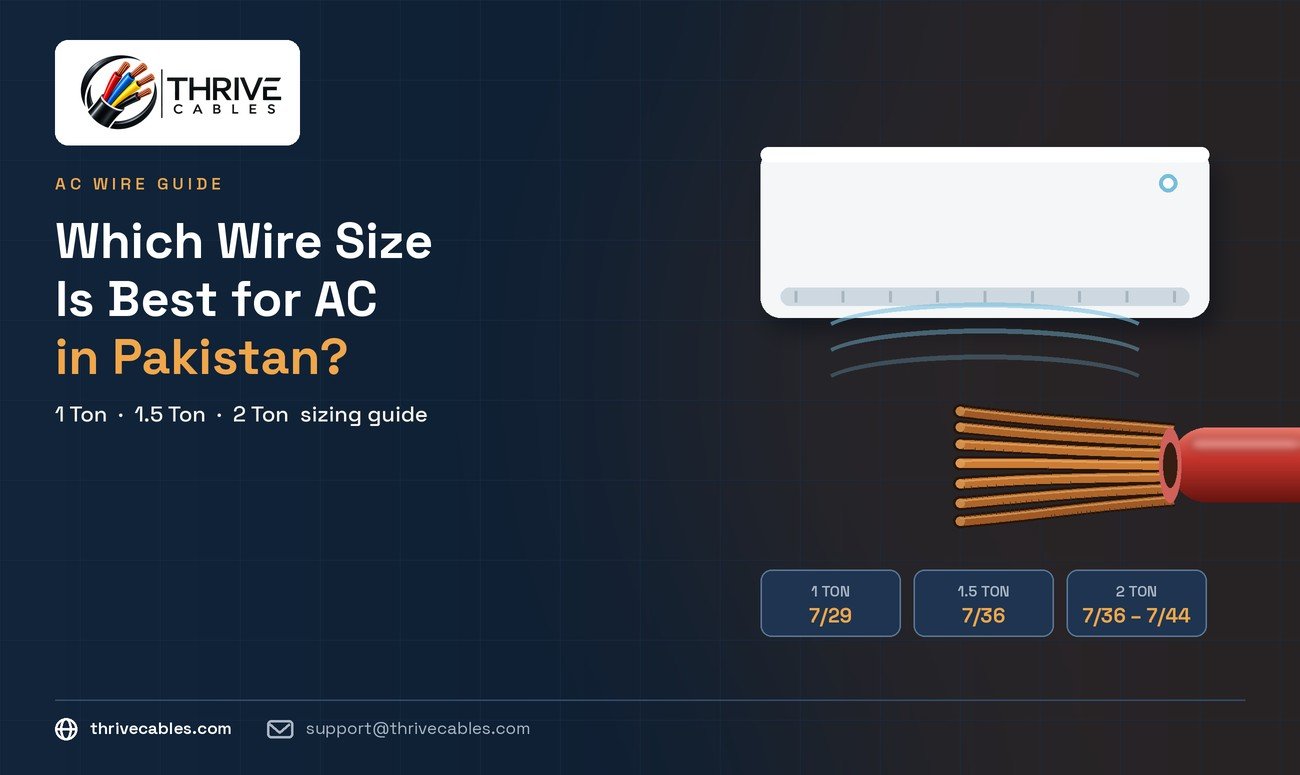
| 1 ton | 7/29 (2.5 mm²) | 7/36 (4 mm²) |
| 1.5 ton | 7/29 (2.5 mm²) minimum, 7/36 preferred | 7/36 (4 mm²) |
| 2 ton | 7/36 (4 mm²) | 7/44 (6 mm²) |
| Two or more ACs on one sub-main | 7/44 (6 mm²) | 7/52 (10 mm²) |
1 Ton AC: 7/29 (2.5 mm²) copper wire is normally enough for a dedicated circuit at a reasonable distance from the distribution board.
1.5 Ton AC: This is the most common size in Pakistani homes. 7/29 is acceptable on a short, dedicated run, but most electricians prefer 7/36 (4 mm²) because it keeps the wire cooler and reduces voltage drop over the long summer hours.
2 Ton AC: Use 7/36 (4 mm²) as the minimum. For longer runs or where several heavy appliances share the same area of the house, step up to 7/44 (6 mm²).
More than one AC: If two or more ACs are fed from the same sub-main line, that sub-main should be 7/44 (6 mm²) or 7/52 (10 mm²), even though each AC point has its own branch and breaker.
Always ask a qualified electrician to confirm the size for your exact load, cable length, and installation.
The tonnage of the AC is only the starting point. Two houses can install the same 1.5 ton unit and still need different wire sizes, because the conditions around the circuit are different. Before you finalise a size, check the five factors below with your electrician, since any one of them can push the requirement up by a full size.
Distance from the distribution board. This is the single biggest factor. A 1.5 ton AC ten meters from the board and the same AC twenty-five meters away are not the same job. Longer runs need a thicker conductor.
Inverter or non-inverter. Inverter ACs modulate their load and are gentler on the wiring, while non-inverter units hit the circuit hard every time the compressor starts.
Voltage in your area. In neighbourhoods where the supply already sags in the evening, a thicker wire helps the AC receive closer to its proper voltage instead of struggling on low supply.
Conduit and heat. Several wires bundled in one conduit, or a run through a hot roof space, all reduce how much current a wire can safely carry.
Aluminium versus copper. Some installers still use aluminium wire for AC points because it is cheaper. Aluminium carries less current for the same size, loosens at terminals over time, and is far more likely to cause a hot joint. For an AC, use copper.
An air conditioner has a metal body, an outdoor unit exposed to rain, and a compressor that can develop a fault over the years. Without proper earthing, a fault has no safe path to travel, and the metal body itself can become live.
Run a proper earth conductor to every AC point along with the phase and neutral. For most residential AC points, 1/.044″ solid earthing wire in standard green insulation is used, connected back to the building’s earthing system.
Most AC wiring failures are not caused by the air conditioner or even by bad luck. They come from a handful of shortcuts taken at installation, usually to save a little money or an hour of work. These are the mistakes we see most often in homes across Pakistan, and each one is easy to avoid if you catch it before the walls are closed.
Running the AC off an existing socket circuit. A socket circuit already feeds irons, kettles, and other appliances. Adding an AC to it overloads the wire and the breaker.
Using 3/29 wire for an AC point. 3/29 is a lighting wire with about 1.29 mm² of copper. On an AC circuit it overheats, and that heat slowly destroys the insulation. Our guide on 3/29 vs 7/29 wire explains the difference in detail.
Ignoring the run length. Choosing the wire by AC tonnage alone, without considering how far the point is from the board, is the most common sizing error.
Poor joints and loose terminals. Even a correctly sized wire will overheat at a loose screw or a twisted joint. AC circuits should have firm, properly tightened terminations and as few joints as possible.
Skipping the dedicated breaker. Each AC should have its own MCB of the correct rating, sized by your electrician to match both the AC and the wire feeding it.
At Thrive Cables, we manufacture every size used on AC circuits in Pakistan: 7/.029″ (2.5 mm²) for 1 ton and shorter 1.5 ton runs, 7/.036″ (4 mm²) for most 1.5 ton and 2 ton points, and 7/.044″ or 7/.052″ for sub-mains feeding several units. Our 1/.044″ solid earthing wire completes the circuit safely.
Every coil is made in Lahore from pure electrolytic copper, checked for strand diameter during production, insulated with fire-retardant PVC, and measured to full length before it is sealed, so the wire carrying your AC load is exactly the wire you paid for.
These are the questions homeowners and electricians ask us most before an AC installation, from the right size for a 1.5 ton unit to whether copper is really worth the extra cost. If your situation is not covered here, share the AC tonnage and the distance from your distribution board with our team and we will point you to the correct size.
Which wire is best for a 1.5 ton AC in Pakistan?
7/29 (2.5 mm²) is the minimum for a short dedicated run, but 7/36 (4 mm²) is the safer choice for most installations, especially when the AC point is far from the distribution board.
Can I use 3/29 wire for an air conditioner?
No. 3/29 is designed for lights and fans. On an AC circuit it will overheat, damage its own insulation, and create a fire risk.
What wire size is needed for a 2 ton AC?
Use 7/36 (4 mm²) as the minimum, and move up to 7/44 (6 mm²) for long runs or where the supply voltage is weak.
Does an AC need a separate circuit?
Yes. Every AC should have its own wire run from the distribution board and its own breaker, never shared with sockets or lighting.
Is copper or aluminium wire better for an AC?
Copper. It carries more current for the same size, holds terminations better, and is far less likely to develop a hot, loose joint on a heavy appliance circuit.
Choosing the right wire for an AC in Pakistan comes down to three things: the tonnage of the unit, the distance from the distribution board, and the quality of the copper you buy. As a working rule, 7/29 suits a 1 ton unit, 7/36 is the safer choice for 1.5 ton and 2 ton units, and 7/44 or larger belongs on long runs and sub-mains feeding multiple ACs.
Spend a little more on the wire once, and you avoid tripping breakers, wasted electricity, and the far bigger cost of opening walls to rewire a circuit that should have been sized correctly the first time.
Tell us the size and quantity. We reply on WhatsApp the same day.